
13
Jul
2026
Social Media Effects on Teenage Mental Health Explained
July 13, 2026
Social media effects on teenage mental health are a growing concern for families across the US – discover what the research says, what warning signs to watch for, and how parents can take action today. (158 chars)
Table of Contents
- What Are Social Media Effects on Teenage Mental Health?
- How Social Platforms Shape Teen Emotional Health
- Gender Differences, Sleep Disruption, and Risk Factors
- What Parents Can Do to Protect Teen Mental Health
- Frequently Asked Questions
- Parental Control Approaches Compared
- How Boomerang Parental Control Helps
- Practical Tips for Families
- The Bottom Line
- Sources & Citations
Article Snapshot
Social media effects on teenage mental health is the measurable impact that platforms like Instagram, TikTok, and Snapchat have on adolescent emotional well-being, self-image, sleep, and behavior. Research consistently links heavy use to increased anxiety, depression, and self-harm risk, while moderated, supervised use carries social benefits when paired with clear parental boundaries.
Quick Stats: social media effects on teenage mental health
- 19% of teens say social media hurt their mental health – rising to 25% among teen girls (Pew Research Center, 2025)[1]
- 45% of teens say social media hurt their sleep, including 50% of teen girls (Pew Research Center, 2025)[1]
- 11% of adolescents in WHO Europe data show signs of problematic social media behavior – up from 7% in 2018 (World Health Organization Regional Office for Europe, 2024)[2]
- 59% of US teens reported experiencing abusive online behaviors (Mental Health America, 2024)[3]
What Are Social Media Effects on Teenage Mental Health?
Social media effects on teenage mental health describe the direct and indirect ways that daily platform use shapes how adolescents think, feel, and behave. These effects range from heightened anxiety and depression to disrupted sleep, poor body image, and in the most serious cases, self-harming behavior and suicidal ideation. At Boomerang Parental Control, we work with families navigating exactly these concerns every day, helping parents set boundaries that reduce exposure without cutting teens off from the social connections that matter to them.
The relationship between screen time and emotional health is not simple. Platforms are designed to hold attention through endless scrolling, notification cycles, and social comparison – features that are particularly activating for adolescent brains still developing impulse control and emotional regulation. When a 13-year-old checks Instagram 40 times before bed, the impact is not just lost sleep. It reshapes how they see themselves relative to peers, curated highlight reels, and influencer culture.
START YOUR FREE TRIAL
Take control of screen time—free for 14 days, cancel anytime.




Psychiatrist Vasilis Vitas, lead author of a peer-reviewed review published in PMC, stated plainly: “Smartphone and social media use among teenagers relates to an increase in mental distress, self-harming behaviors, and suicidality.” (Vasilis Vitas, 2023)[4] That is a strong clinical statement, and it reflects a growing consensus across research institutions.
Not every teen is affected equally. Risk is shaped by age, existing mental health conditions, the type of content consumed, and whether a trusted adult is present to help them process what they see. For parents handing a child their first smartphone – particularly a pre-teen – understanding these risks upfront is the most protective step they can take. Early guardrails set the tone for healthy digital habits long before problematic patterns have a chance to form. The Boomerang Parental Control software review on TechRadar highlights how tools like Boomerang address these concerns in practical, family-friendly ways.
How Social Platforms Shape Teen Emotional Health
Social platforms affect teenage emotional health through several well-documented psychological mechanisms, including social comparison, fear of missing out, cyberbullying, and dopamine-driven engagement loops. Understanding these mechanisms helps parents move from vague worry to specific, targeted action.
Social comparison is one of the most studied pathways. Teens who spend significant time viewing idealized images of peers, celebrities, or influencers report lower self-esteem and higher rates of body dissatisfaction – particularly among girls. This is not incidental to how platforms work; it is built into the design. Content algorithms prioritize engagement, and emotionally charged or aspirational content consistently generates more interaction than neutral posts.
Cyberbullying represents a distinct and serious harm. Mental Health America reported that 59% of US teens experienced abusive online behaviors, with 42% specifically experiencing name-calling online (Mental Health America, 2024)[3]. These are not isolated incidents. For many teens, online harassment is a recurring part of their social experience, and its effects – shame, anxiety, school avoidance – carry directly into offline life.
The dopamine loop created by likes, comments, and follower counts mimics the reward pathways activated by other addictive behaviors. Teens check platforms compulsively for social validation, and when that validation does not arrive, the emotional crash is sharp. Mayo Clinic clinical guidance notes that “using social media more than three times a day predicted poor mental health and well-being in teens” (Mayo Clinic staff, 2024)[5] – a finding that gives parents a concrete usage threshold to consider.
Fear of missing out, known as FOMO, drives teens to stay connected even when they are tired or anxious. Group chats and stories create a sense that something important is always happening just out of reach, making it genuinely difficult for teenagers to disconnect voluntarily. This is one reason why automated screen time tools – not willpower – are the most effective boundary-setting mechanism for most families. You can explore Boomerang Parental Control’s screen time features to see how scheduled downtime removes the manual battle entirely.
Why Content Type and Usage Duration Both Matter
Not all social media use carries equal risk. Passive scrolling – consuming content without interacting – is more strongly linked to depressive symptoms than active use, such as messaging friends directly or sharing personal updates. Research from the University of Pittsburgh shows that individual developmental level and protective factors like strong family relationships shape how much any given level of use affects a teen. As Brian A. Primack, Director of the Center for Research on Media, Technology, and Health at the University of Pittsburgh, explained: “There is a ‘sweet spot’ of use for each child that is often specific to their own developmental level and protective factors.” (Brian A. Primack, 2024)[6]
This means the goal for parents is not necessarily zero social media – it is calibrated, supervised use that matches the child’s maturity. Setting per-app time limits, keeping devices out of bedrooms at night, and staying curious about what your teen is actually watching all contribute to healthier outcomes than an outright ban that breeds resentment and workarounds.
Gender Differences, Sleep Disruption, and Risk Factors
The social media effects on teenage mental health are not distributed evenly across all teens – gender, age, and sleep behavior are among the strongest predictors of who is most at risk. Data consistently shows that teen girls bear a disproportionate share of the harm, and that sleep disruption is one of the clearest measurable pathways between platform use and poor wellbeing.
Pew Research Center’s 2025 data found that 25% of teen girls say social media hurt their mental health, compared to 14% of teen boys (Pew Research Center, 2025)[1]. This gap is consistent with clinical research showing that girls are more likely to engage in social comparison on image-heavy platforms and more likely to experience cyberbullying in the form of relational aggression – exclusion, rumor-spreading, and targeted harassment.
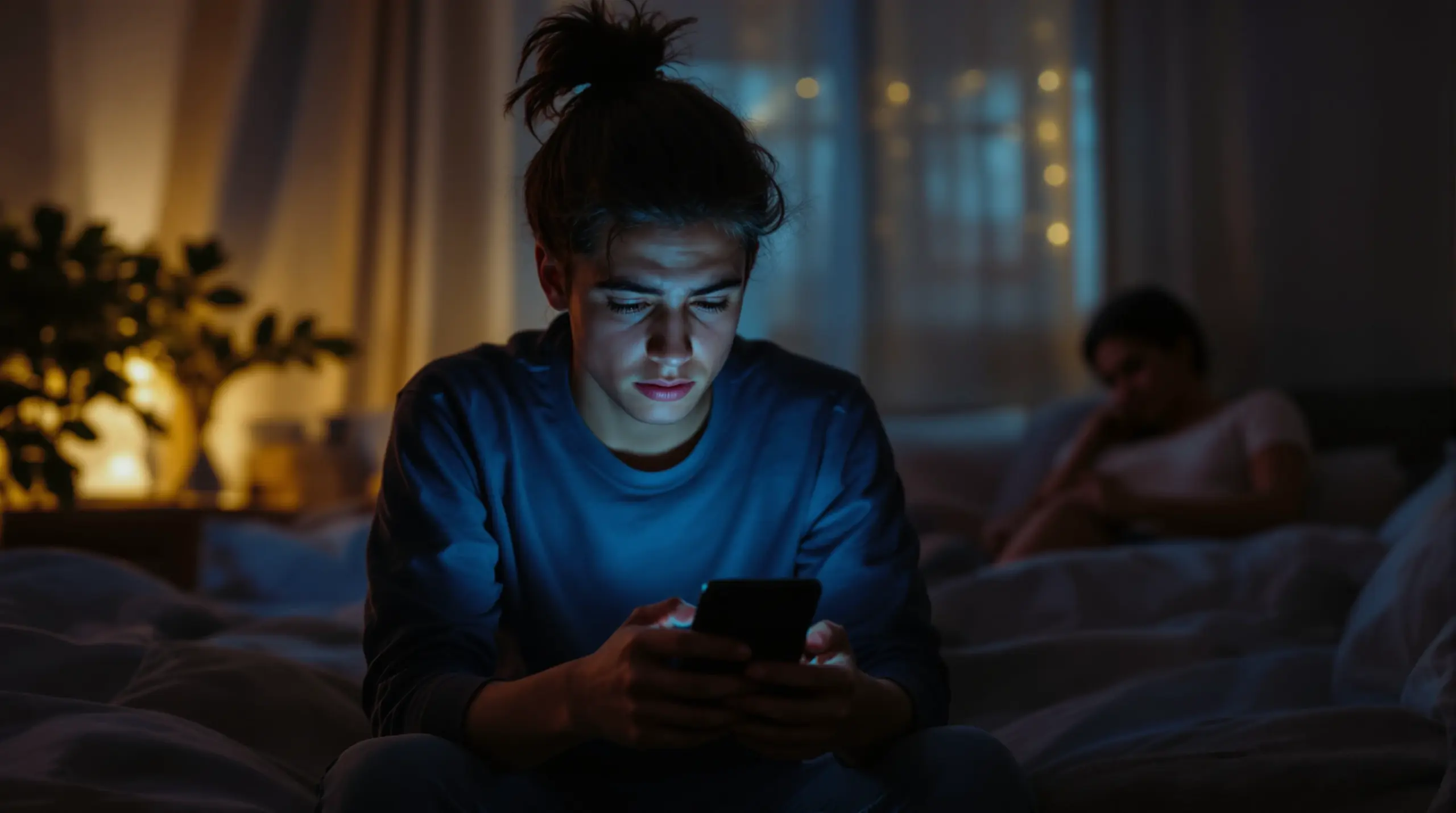
Sleep is perhaps the most underappreciated casualty of unchecked platform use. Forty-five percent of teens say social media hurt their sleep, including 50% of teen girls and 40% of teen boys (Pew Research Center, 2025)[1]. Poor sleep in adolescence is not a minor inconvenience. Chronic sleep deprivation in teenagers is linked to impaired memory consolidation, increased emotional reactivity, lower academic performance, and higher rates of depression and anxiety. When a teen is scrolling TikTok at midnight, the harm compounds: the blue light suppresses melatonin, the emotionally stimulating content activates the nervous system, and the morning starts with a deficit that accumulates across the school week.
Risk Amplifiers: Who Is Most Vulnerable?
Certain factors amplify vulnerability to negative social media effects. Pre-existing anxiety or depression, limited parental involvement, no established digital boundaries, and access to devices in the bedroom without time restrictions all increase risk. Teens who use platforms as their primary social outlet – replacing face-to-face interaction rather than supplementing it – show higher rates of loneliness and disconnection despite being technically more “connected” online.
The World Health Organization Regional Office for Europe reported that problematic social media use among adolescents rose from 7% in 2018 to 11% in 2022, a four-percentage-point increase in just four years (World Health Organization Regional Office for Europe, 2024)[2]. This trajectory reflects a real-world shift in how embedded platforms have become in daily teen life, and it underscores why families who set boundaries early – before habits are entrenched – are in a meaningfully better position. SafeWise’s review of Boomerang Parental Control offers a useful independent perspective on how parental control tools address these real family challenges.
What Parents Can Do to Protect Teen Mental Health
Parents have more influence over their teen’s digital environment than many realize, and the most effective interventions combine clear rules, reliable technology, and consistent conversation. Reactive approaches – taking the phone away after a crisis – are far less effective than proactive structures established before unhealthy patterns develop.
The first step is establishing non-negotiable device-free times. Bedrooms at night, mealtimes, and homework blocks should be protected by rules that do not require daily renegotiation. This is easier said than done when the child controls the device, which is exactly why automated scheduling tools exist. When the phone locks itself at 9:00 p.m. because a parent set that rule once, the argument shifts from “you need to put it away” to a simple fact: the phone is off. That shift reduces conflict significantly and places the boundary with the technology rather than with the parent.
App approval control is equally important, particularly for younger teens and pre-teens. New social media platforms emerge constantly, and children often install apps their parents have never heard of before parents become aware they exist. Requiring parental approval for every new app install – before the child can open it – creates a gate at the point of maximum risk. This is not about distrust; it is about being an active participant in your child’s digital life rather than a passive bystander.
Content visibility matters too. Knowing what your teen is watching gives you the raw material for real conversations. YouTube, in particular, operates through a recommendation algorithm that leads a child from innocuous content into genuinely disturbing territory without a single active search. Having visibility into viewing history – without surveilling every message – gives parents enough context to check in meaningfully. On Android devices, Boomerang’s YouTube App History Monitoring provides exactly this kind of window into what your child is actually watching, so conversations are specific and informed rather than generic and dismissed.
Finally, location awareness reduces the anxiety that pushes parents toward over-restriction. When you know your teen arrived safely at school or a friend’s house, you are less likely to compensate with overly strict digital rules. Geofencing alerts remove the need for check-in texts and build a low-friction layer of safety that teenagers tolerate better than constant calls. You can download Boomerang for Android devices to access these features, including the full suite of location and communication safety tools.
Your Most Common Questions
How much social media use is too much for teenagers?
There is no single number that applies to every teen, but clinical research provides useful reference points. Mayo Clinic guidance notes that using social media more than three times a day predicted poor mental health outcomes in teenagers (Mayo Clinic staff, 2024)[5]. The University of Pittsburgh’s research shows that a healthy amount of use is individual – shaped by the teen’s age, existing mental health, and whether they have strong protective factors like close family relationships and face-to-face friendships.
As a practical starting point for families, many child health experts recommend no social media use during the hour before bed, no devices in the bedroom overnight, and a daily total that leaves significant time for offline activities – exercise, homework, family interaction, and unstructured play. On Android devices, Boomerang Parental Control allows parents to set both daily usage limits and specific scheduled downtime windows, enforcing these boundaries automatically without requiring nightly arguments. The goal is calibrated use that matches the child’s developmental stage, not a blanket ban that generates resentment and workarounds.
What are the warning signs that social media is harming my teen’s mental health?
Warning signs fall into several categories: behavioral, emotional, and physical. Behaviorally, watch for a teen who becomes agitated or anxious when their device is taken away, who stays up late to use platforms despite known rules, who has withdrawn from offline friendships, or who becomes secretive about what they are viewing or who they are talking to. Emotionally, signs include increased irritability, low self-esteem comments about their appearance or social status, tearfulness after phone use, and expressions of feeling excluded or unlikable.
Physically, disrupted sleep is the most reliable early signal. A teen who is chronically tired, struggles to wake up for school, or complains of fatigue despite adequate bed time is staying up on their phone long after lights-out. Forty-five percent of teens report social media hurt their sleep (Pew Research Center, 2025)[1], making this the single most common measurable harm. If you notice these signs, start by removing device access from the bedroom at night, then open a conversation focused on curiosity rather than accusation. Tools like Boomerang’s scheduled downtime enforce the physical boundary while you work on the conversation.
Are teen girls more at risk from social media than teen boys?
Yes – consistently across multiple data sources, teen girls show higher rates of harm from social media use than teen boys. Pew Research Center’s 2025 data found that 25% of teen girls say social media hurt their mental health, compared to 14% of teen boys (Pew Research Center, 2025)[1]. Similarly, 50% of teen girls say social media hurt their sleep versus 40% of teen boys.
Researchers point to several reasons for this disparity. Girls are more likely to use image-heavy platforms where social comparison around appearance is constant, more likely to experience relational forms of cyberbullying such as exclusion and rumor spreading, and more likely to engage in passive scrolling behavior – consuming without interacting – which is more strongly linked to depressive symptoms than active use. This does not mean boys are unaffected; clinical concern exists across all genders. But it does mean that parents of teenage daughters should pay particular attention to which platforms their daughter uses, how much time she spends on them passively versus actively, and whether she has strong offline social connections to buffer against online comparison pressure.
Can parental control apps actually reduce the mental health risks of social media?
Parental control apps address the structural conditions that make social media most harmful – unlimited access, no bedtime enforcement, no visibility into what a child is consuming – while leaving room for healthy, supervised use. They cannot replace conversations, family connection, or professional support when a teen is already struggling. But they create the environment in which healthier habits are more likely to form.
The most effective parental control tools for managing social media risks combine automated time limits that remove the device from the equation at bedtime, app-level controls that allow parents to limit specific platforms without banning the phone entirely, and visibility features that give parents enough context to have informed conversations. On Android devices, Boomerang Parental Control offers all three: scheduled screen time, per-app limits, and YouTube viewing history. For parents concerned about a tech-savvy teen bypassing controls, Boomerang’s Uninstall Protection – reinforced by Samsung Knox integration on supported Samsung devices – makes the app exceptionally difficult to remove. Together, these tools shift the dynamic from daily conflict to consistent, automated boundaries that both parent and teen rely on.
Parental Control Approaches Compared
Parents choosing how to manage their teen’s social media exposure have several approaches available, ranging from built-in device tools to dedicated parental control apps. Each differs significantly in what it enforces, how easily a motivated teenager works around it, and how much visibility it gives parents into actual platform use.
| Approach | social media effects on teenage mental health mitigation | Bypass Resistance | Visibility Into Usage | Bedtime Enforcement | App-Level Controls |
|---|---|---|---|---|---|
| No controls (status quo) | None | Not applicable | None | Manual only | None |
| Built-in tools (Apple Screen Time / Google Family Link) | Moderate – basic limits possible | Low – commonly bypassed by tech-savvy teens | Limited screen time summaries only | Available but easily disabled | Basic app blocking only |
| Dedicated parental control app (e.g., Boomerang) | High – automated limits reduce exposure to key risk windows | High – Uninstall Protection + Samsung Knox on supported devices[7] | YouTube App History Monitoring (Android); activity reports | Automated Scheduled Downtime enforced by app | Per-app time limits + Encouraged Apps (Android) |
| Family agreement only (no technology) | Low – relies entirely on teen compliance | None | None | Manual only | None |
How Boomerang Parental Control Helps Families
Boomerang Parental Control – Taking the battle out of screen time for Android and iOS was built to address the exact mechanisms through which social media harms teenagers: unlimited access, no bedtime enforcement, invisible content consumption, and easy bypass of basic controls. Our platform gives parents the tools to set firm, automated boundaries that stay in place even when a tech-savvy teen knows they are there.
On Android devices – where our feature set is deepest – Boomerang’s YouTube App History Monitoring shows parents what their child has been watching and searching for in the main YouTube app. This is not a hypothetical risk feature; it is the kind of visibility that turns vague anxiety into specific, informed conversations. You know what your child was watching at 11:00 p.m. You can ask about it. That changes the dynamic from suspicion to dialogue.
Our Scheduled Downtime and Daily Limits features enforce bedtime and usage caps automatically, removing the device from the argument. When the phone locks itself at the agreed time, neither parent nor child has to be the enforcer. The boundary is neutral, consistent, and reliable – exactly what research on adolescent behavior shows works better than reactive rule-setting.
For families with Samsung Android devices, Boomerang Parental Control is the only parental control app to use Samsung Knox, Samsung’s enterprise-grade mobile security framework. This makes Boomerang exceptionally difficult to uninstall or bypass – a critical differentiator for parents of teenagers who have already defeated Google Family Link or Apple Screen Time.
“Hey fellow parents, So far this the best parental control app .. hands down. So far the only app my 11 year old was not able to bypass. Big Shout out to developers for making such a great app.” – Jason H, Google Play review
“I have control back over my child’s phone and applications because she managed to circumvent family link. I have no idea how she did that but she managed to find a way, as did other kids. That was a major frustration for us. But now with Boomerang, I can manage her time, what applications she uses and what sites she visits.” – Joe Eagles, Google Play review
SPIN Safe Browser, Boomerang’s companion product, adds an additional layer of content protection. It blocks millions of inappropriate websites automatically and enforces SafeSearch on major search engines – without requiring VPN configuration or router changes. It works on any network your child joins, including school wifi, friends’ homes, and mobile data. Contact us at [email protected] or visit our contact page to learn more or get started.
Practical Tips for Families Managing Social Media Risks
The research on social media and teen mental health points toward concrete, actionable steps rather than sweeping bans. Here are the practices most consistently supported by clinical guidance and family experience.
Move charging to a common area at night. The single most protective structural change a family makes is keeping devices out of bedrooms overnight. This eliminates late-night scrolling, protects sleep, and removes the temptation to check notifications during sleep-disrupted wake periods. Pair this with an automated bedtime lock on the device so the rule is enforced even if the charger migrates back to the bedroom.
Use per-app time limits for high-risk platforms. Banning social media entirely often backfires with teenagers, creating resentment and underground workarounds. A more sustainable approach is setting a specific daily limit for TikTok, Instagram, or Snapchat – say, 30 to 45 minutes – while leaving other apps unrestricted. On Android, Boomerang’s per-app limit feature makes this precise and automated.
Designate educational and wellness apps as always-on. Boomerang’s Encouraged Apps feature lets parents mark specific apps – school portals, reading apps, fitness trackers – as exempt from daily limits. This teaches children that not all screen time is equal, and it reinforces the message that technology is a tool, not an entitlement.
Review app installs before they happen. Boomerang’s App Discovery and Approval workflow requires your sign-off before a child uses any newly installed app. This gate is most valuable for pre-teens and younger teens who do not always recognize a risky platform when they see one.
Stay curious, not accusatory. When you have visibility into your child’s YouTube history or see that they were on their phone until 1:00 a.m., the most productive approach is a question, not a confrontation. “I noticed you were watching a lot of content about X – what do you think about that?” opens a conversation. Accusation closes it. Technology gives you the facts; your relationship gives you the access to actually help.
Finally, watch for the warning signs discussed throughout this article – disrupted sleep, withdrawal from offline friends, irritability after phone use, and anxiety when the device is unavailable. These are your early indicators that the current level and type of social media use is doing harm, and they are the signal to adjust boundaries and seek professional support if needed.
The Bottom Line
Social media effects on teenage mental health are real, measurable, and unevenly distributed – teen girls, heavy passive users, and adolescents without digital boundaries carry the greatest risk. But the research also makes clear that the most harmful outcomes are closely tied to specific, addressable conditions: unrestricted access, no bedtime enforcement, invisible content consumption, and controls that are easily bypassed.
Parents who act early – setting automated boundaries, staying curious about what their teen consumes, and choosing tools that actually hold – are in a fundamentally stronger position than those who wait for a crisis. Boomerang Parental Control was designed for exactly this purpose: to give families the structure and visibility they need to guide teens toward healthier digital habits without constant conflict.
If you are ready to take a practical first step, visit Boomerang Parental Control to explore our features, or reach out at [email protected] to get personalized guidance on setting up the right configuration for your family’s devices.
Sources & Citations
- Teens, Social Media and Mental Health. Pew Research Center.
https://www.pewresearch.org/internet/2025/04/22/teens-social-media-and-mental-health/ - Teens, screens and mental health. World Health Organization Regional Office for Europe.
https://www.who.int/europe/news/item/25-09-2024-teens–screens-and-mental-health - Social Media and Youth Mental Health. Mental Health America.
https://mhanational.org/resources/social-media-and-youth-mental-health/ - The Impact of Social Media on the Mental Health of Adolescents and Young Adults: A Systematic Review. PMC.
https://pmc.ncbi.nlm.nih.gov/articles/PMC10476631/ - Teens and social media use: What’s the impact? Mayo Clinic.
https://www.mayoclinic.org/healthy-lifestyle/tween-and-teen-health/in-depth/teens-and-social-media-use/art-20474437 - Social Media and Mental Health in Children and Teens. Johns Hopkins Medicine.
https://www.hopkinsmedicine.org/health/wellness-and-prevention/social-media-and-mental-health-in-children-and-teens - Boomerang Parental Control Samsung Knox Information. Boomerang Parental Control.
https://useboomerang.com/boomerang-parental-control-samsung-knox-information/
START YOUR FREE TRIAL
Take control of screen time—free for 14 days, cancel anytime.
