
24
Apr
2026
Parental Controls Chromebook: A Complete Guide
April 24, 2026
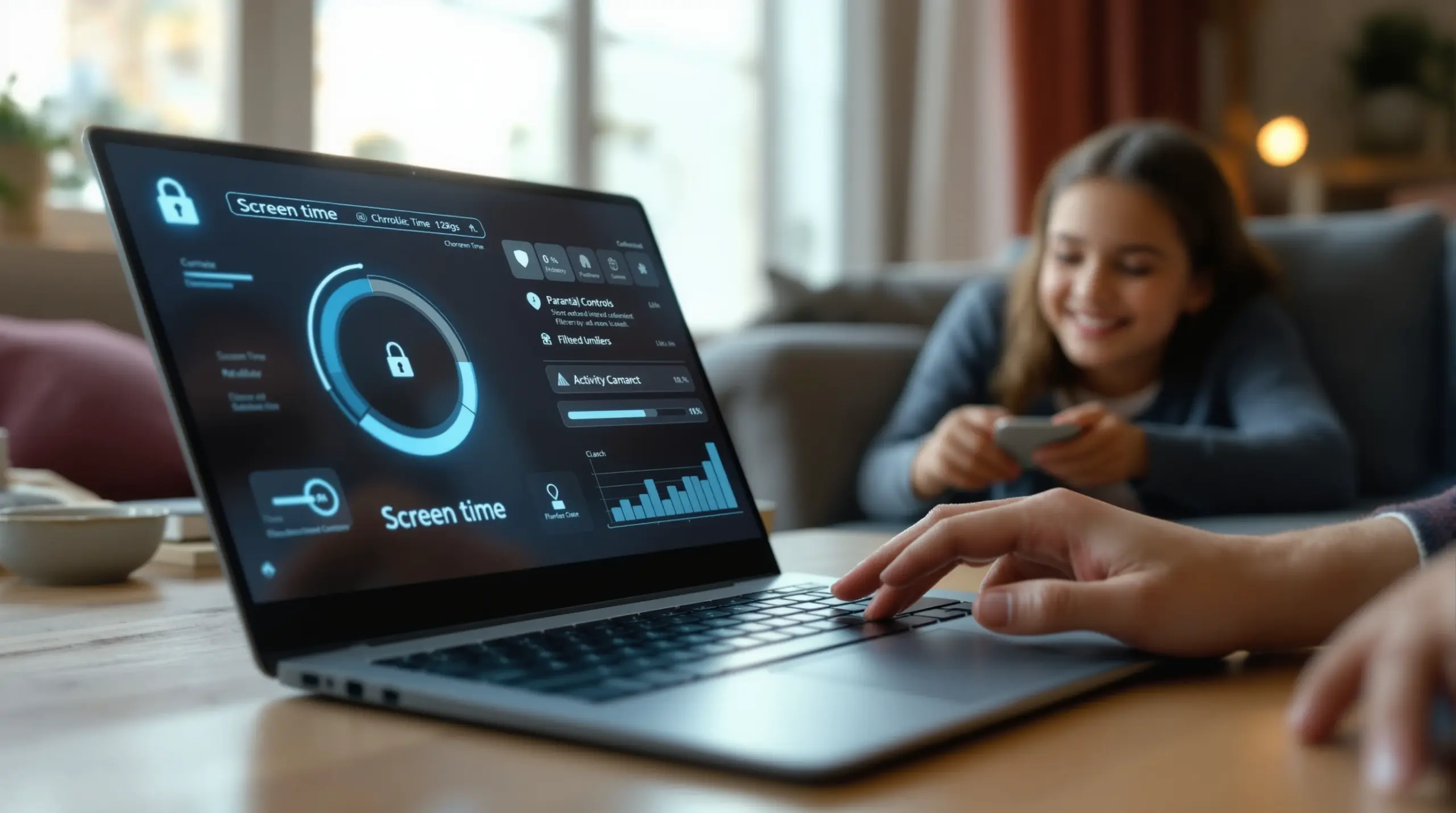
Parental controls Chromebook setup helps families manage screen time, filter harmful content, and monitor activity – discover the best tools and strategies to keep your child safe online.
Table of Contents
- What Are Chromebook Parental Controls?
- Setting Up Google Family Link on a Chromebook
- Beyond Family Link: Advanced Controls and Monitoring
- AI Features and Emerging Online Risks on Chromebooks
- Frequently Asked Questions
- Comparing Chromebook Parental Control Approaches
- How Boomerang Parental Control Supports Your Family
- Practical Tips for Managing Chromebook Use at Home
- The Bottom Line
- Sources & Citations
Article Snapshot
Parental controls Chromebook is a set of built-in and third-party tools that let parents restrict websites, set screen time schedules, approve apps, and monitor a child’s online activity. Google Family Link is the primary native solution, requiring Chrome OS version 65 or higher to function on a supervised child account.
Quick Stats: parental controls chromebook
- Chrome OS version 65 or higher is required to use Google Family Link parental controls on a Chromebook (Bark, 2024)[1]
- 3 primary parental control methods are available for Chromebook management (TechPP, 2024)[2]
- 2 screen time schedule types – School Time and Downtime – are available through Family Link (Google Family Link, 2025)[3]
- All Chromebook models released after 2023 include Google’s Gemini AI built into the software (Protect Young Eyes, 2025)[4]
What Are Chromebook Parental Controls?
Parental controls Chromebook tools are a combination of built-in Google features and third-party applications that give parents authority over how, when, and where their child uses a Chromebook. Chromebooks run Chrome OS, a lightweight operating system designed by Google, and they are among the most popular devices in schools and homes across North America. At Boomerang Parental Control, we help families understand the overlapping range of device controls – and understanding what a Chromebook can and cannot do natively is the first step.
The primary built-in solution is Google Family Link, a free parental supervision tool that works by creating a supervised Google account for your child. When that account is linked to a Chromebook, you gain access to content filtering, screen time scheduling, app approval, and activity monitoring – all managed from a parent’s smartphone. As Internet Matters noted, “There are a range of parental controls for ChromeOS that you can use alongside Google Family Link to manage and monitor children’s online use” (Internet Matters, 2025)[5].
START YOUR FREE TRIAL
Take control of screen time—free for 14 days, cancel anytime.




For families handing their child their first Chromebook – particularly in the 8 to 12 age range – built-in supervised accounts provide a useful foundation. You can restrict Google Search results to SafeSearch, limit the websites the child can visit, and receive weekly activity reports. These baseline Chromebook content restrictions reduce the chance of accidental exposure to harmful material during unstructured browsing time.
However, native Family Link controls have meaningful gaps. They work primarily within the Google ecosystem, meaning a resourceful child can find workarounds through extensions, guest modes, or alternate browsers if those access points are not also locked down. For parents who need layered protection – particularly on Android phones their child also carries – adding a dedicated parental control app alongside Chromebook-native tools provides a more complete safety net. The Boomerang Parental Control software review on TechRadar outlines how a multi-device approach strengthens the overall family safety setup.
Setting Up Google Family Link on a Chromebook
Configuring Google Family Link on a Chromebook involves creating a supervised child account and linking it to the parent’s Family Link app before the child signs into the device. This process is straightforward but requires Chrome OS version 65 or higher to work correctly (Bark, 2024)[1]. If the Chromebook is running an older version of Chrome OS, you will need to update the device before supervised account features become available.
Once set up, Family Link provides parents with several key control categories directly from their phone:
- Website filtering: Three filtering options let you allow all sites, try to block mature content, or only allow approved sites (Google Support, 2025)[6]. The most restrictive setting requires you to manually approve every website your child wants to visit.
- Screen time scheduling: Two schedule types – School Time and Downtime – let you block device access during specific windows automatically (Google Family Link, 2025)[3]. Daily usage limits can also be applied so the Chromebook locks once the child’s allotment is used up.
- App and extension approvals: Parents receive notifications when a child requests a new Chrome extension or app and can approve or deny it remotely.
As Geek Squad Agent Read explains, “Set up parental controls to limit what sites your kids have access to on their Chromebook. You can create content restrictions, filter out Google search results, block unwanted websites and even set up screen time limits that work across all of their devices” (Geek Squad Agent Read, 2024)[7]. The cross-device nature of Family Link is genuinely useful for families where the same child uses both a Chromebook and an Android phone – the daily limits apply to both devices from a single parent dashboard.
Family Link also allows parents to manage four Google services – Google Search, YouTube, Google Play, and Google Assistant – setting age-appropriate restrictions for each (Google Family Link, 2025)[3]. Locking YouTube to supervised viewing or disabling Play Store access for the Chromebook are practical steps that reduce exposure to age-inappropriate content without requiring the child to use a completely restricted device.
TechPP confirms the accessibility of this setup: “You can set screen time limits, block apps, and monitor your child’s activity directly from your phone using Google Family Link App on your Chromebook” (TechPP, 2024)[2]. For non-technical parents, the smartphone-centric management interface makes ongoing supervision manageable without needing to touch the child’s device daily.
Managing Website Permissions on a Chromebook
Beyond category-level filtering, Google Family Link lets parents control three types of website permissions on a Chromebook: allowing specific sites, blocking specific sites, and setting exceptions to the general filter level (Google Support, 2025)[6]. This granular permission system means you can block a distraction site like a gaming portal while keeping an educational resource open, regardless of how the general filter is configured. Pair this with SafeSearch enforcement across Google, Bing, and Yahoo, and you have a reasonable baseline for elementary-aged children during homework hours.
Beyond Family Link: Advanced Controls and Monitoring
Google Family Link covers the essentials, but families who need stronger enforcement or deeper visibility will find its limitations frustrating – particularly with teenagers who are motivated to find workarounds. Three primary methods exist for managing parental controls on a Chromebook (TechPP, 2024)[2]: native Family Link, Chrome browser extensions, and third-party parental control software used alongside the Chromebook.
Chrome browser extensions designed for child safety can add filtering layers that Family Link does not natively provide. However, extensions have a critical weakness: a child with enough Chromebook access can disable or remove them through Chrome’s extension manager unless the parent has locked the browser settings. For a supervised account, the parent controls extension installation, which limits this risk – but it also means every protective extension needs to be parent-approved and installed from the parent’s Family Link interface.
Third-party parental control apps represent the strongest option for families managing multiple devices. While dedicated Chromebook parental control software running natively on Chrome OS is limited compared to what is available on Android, many families use a layered approach: Family Link handles the Chromebook, while a comprehensive app like Boomerang Parental Control – Taking the battle out of screen time for Android and iOS handles the child’s Android phone or tablet with deeper controls.
This multi-device strategy matters because children rarely use only one device. A child whose Chromebook browsing is tightly controlled may still have unrestricted access through an Android phone. Features like YouTube App History Monitoring, per-app time limits, and Call and Text Safety are Android-exclusive capabilities that no Chromebook solution currently replicates. Families that treat the Chromebook and the Android phone as part of one connected safety plan close the gaps that single-device approaches leave open.
Safe Browsing Options for Chromebook Users
For parents who want a browser-level content filter that works without VPN configuration or router changes, the SPIN Safe Browser provides pre-configured web filtering with automatic SafeSearch enforcement. While SPIN Safe Browser is primarily deployed on Android and iOS devices, it illustrates the kind of always-on, network-independent content filtering that Chromebook families should look for when evaluating their overall protective setup. Effective Chromebook web filtering should work on any network – school wifi, home broadband, and mobile hotspots – not just the home router.
AI Features and Emerging Online Risks on Chromebooks
Every Chromebook released after 2023 includes Google’s Gemini AI built directly into the operating system (Protect Young Eyes, 2025)[4], which introduces a new category of online safety consideration that traditional content filters were never designed to address. Gemini generates text, summarizes web content, and answers open-ended questions – capabilities that expose children to content or ideas that bypass category-based website blocking entirely.
As Protect Young Eyes notes, “There are ways to customize the way your child’s Chromebook uses Gemini and other AI tools” (Protect Young Eyes, 2025)[4]. For supervised accounts managed through Family Link, parents can restrict access to Gemini and other Google AI features through the Family Link app’s Google services controls. However, this requires parents to actively review these settings – the default configuration for a new supervised account does not automatically disable AI features.
Beyond AI, Chromebooks present additional risk surfaces that parents should address proactively. Guest mode, if not disabled, allows anyone to use the Chromebook without any supervised account restrictions active. Extensions downloaded before parental supervision was configured may still be active. And children who use the Chromebook for school may have school-managed accounts that exist alongside their supervised personal account, creating confusion about which account’s rules apply in which context.
Chromebook safety settings should be reviewed as a complete system rather than a single setup task. Disabling guest mode, auditing installed extensions, reviewing Gemini and AI access permissions, and confirming that SafeSearch is enforced across all browsers the child can access are all part of a thorough Chromebook digital safety review. For families also managing Android devices, the Boomerang Parental Control Review on SafeWise provides useful context on how dedicated parental control apps complement device-native settings.
Location and Communication Safety Beyond the Chromebook
Chromebooks do not natively support location tracking or call and text monitoring – these capabilities belong to the mobile device layer of a child’s digital life. For parents managing both a Chromebook and an Android phone for the same child, ensuring that the Android device has real-time location tracking, geofencing alerts, and call and text safety monitoring in place closes the physical safety gaps that Chromebook controls cannot fill. A complete family safety strategy addresses both the stationary device and the mobile device the child carries out of the house.
Your Most Common Questions
Can I set screen time limits on a Chromebook without Google Family Link?
Google Family Link is the primary and most reliable way to set screen time limits on a Chromebook for a child’s account. Without it, you would need to rely on manual device management – physically taking the Chromebook away or using the Chromebook’s built-in user account settings, which offer far less control. Family Link provides two automated schedule types: School Time, which blocks device access during school hours, and Downtime, which locks the device at bedtime (Google Family Link, 2025)[3]. It also allows daily usage limits so the device locks automatically once the child’s allotment is used. Third-party Chrome extensions can add some time management features, but these are easier for children to bypass and do not integrate with a parent’s phone dashboard the way Family Link does. For families looking for strong, automated enforcement that removes parents from the role of daily enforcer, setting up a supervised Family Link account before the child first uses the Chromebook is the most practical approach.
What version of Chrome OS do I need to use parental controls on a Chromebook?
Your child’s Chromebook needs to be running Chrome OS version 65 or higher to support Google Family Link parental controls (Bark, 2024)[1]. Most Chromebooks in active use today are well above this version, as Google pushes automatic updates to Chrome OS regularly. To check the current version on a Chromebook, open the Settings menu, select About Chrome OS, and look at the version number listed. If the device is below version 65, navigate to the same screen and select Check for Updates – the Chromebook will download and install the latest available update automatically when connected to wifi. Keep in mind that older Chromebooks have an Auto Update Expiration date, after which Google stops providing OS updates. If a Chromebook has reached its expiration date, it will not receive further updates and may not support current Family Link features reliably. Checking the device’s update status before setting up parental controls saves frustration during the setup process.
Can my child bypass parental controls on a Chromebook?
Yes, a determined or tech-savvy child can find ways to work around Chromebook parental controls if certain safeguards are not in place. The most common bypass method is using Guest Mode, which lets anyone use the Chromebook without the supervised account restrictions applying. Parents should disable Guest Mode in the Chromebook’s device settings as one of the first steps in their setup. Children may also attempt to sign in with a different, unsupervised Google account or use an alternate browser that does not respect Family Link’s content filters. Ensuring the supervised account is the only account configured on the device, and disabling the ability to add new accounts, closes both of these gaps. For families with teenagers who have already bypassed simpler tools, a dedicated parental control app on the child’s Android phone – one with strong uninstall protection – provides enforcement that is considerably harder to defeat than browser-level or account-level controls alone. Android-specific tools offer a layer of protection that the Chromebook’s native controls simply cannot replicate.
Do parental controls on a Chromebook work on other devices too?
Google Family Link manages three device types through a single parent account: Chromebooks, Android phones and tablets, and some Google TV devices (Google Safety Center, 2025)[8]. Screen time daily limits set through Family Link apply across all linked devices, meaning a child’s total screen time budget is shared between their Chromebook and their Android phone when both are supervised under the same child account. However, the depth of control varies by device. On Android devices, Family Link and dedicated parental control apps like Boomerang provide features that are simply not available on a Chromebook – including YouTube App History Monitoring, per-app time limits, call and text safety monitoring, and uninstall protection. If your child uses both a Chromebook and an Android phone, treating them as a connected system and applying device-appropriate controls to each gives you the most complete protection. Relying on Chromebook controls alone leaves the Android device under-supervised, which is where most unsupervised activity tends to migrate.
Comparing Chromebook Parental Control Approaches
Choosing the right approach to Chromebook parental controls depends on your child’s age, the devices they use, and how much ongoing management you can realistically commit to. The table below compares four common methods families use to manage and monitor Chromebook activity, from built-in tools to dedicated third-party solutions.
| Approach | Screen Time Limits | Content Filtering | Bypass Resistance | Multi-Device Support | Cost |
|---|---|---|---|---|---|
| Google Family Link (native) | Daily limits + 2 schedule types[3] | 3 filtering levels[6] | Moderate – Guest Mode bypass possible | Chromebook, Android, Google TV[8] | Free |
| Chrome Browser Extensions | Limited, extension-dependent | Category-based filtering | Low – removable by child if account not locked | Chrome browser only | Free to paid |
| Dedicated Android Parental Control App (e.g., Boomerang) | Per-app limits + daily limits + scheduling | Web filtering + SPIN Safe Browser | High – uninstall protection + Samsung Knox | Android phone/tablet + iOS (limited) | Subscription |
| Family Link + Dedicated App (layered) | Chromebook limits via Family Link; Android limits via app | Full coverage across both device types | High across all devices | Chromebook + Android + iOS | Free + subscription |
How Boomerang Parental Control Supports Your Family
Boomerang Parental Control is built specifically for families managing Android devices – and it fills the gaps that Chromebook-native tools leave open. While Google Family Link handles the Chromebook side of your child’s digital life, Boomerang takes over the Android phone or tablet with a depth of control that no built-in solution matches.
Our Boomerang Parental Control screen time features include automated daily limits, scheduled downtime for bedtime and homework, and per-app time limits on Android – so you can allow unlimited use of an educational app while capping entertainment apps at 30 minutes. This level of detail is not available through Google Family Link alone.
For parents worried about their child bypassing controls, Boomerang’s Uninstall Protection – reinforced by Samsung Knox integration on supported Samsung devices – makes it exceptionally difficult for even tech-savvy children to remove or disable the app. As one parent shared: “This is a great application! I have control back over my child’s phone and applications because she managed to circumvent family link. I have no idea how she did that but she managed to find a way, as did other kids. That was a major frustration for us. But now with Boomerang, I can manage her time, what applications she uses and what sites she visits.” – Joe Eagles, Google Play review
Boomerang also provides YouTube App History Monitoring on Android, giving you visibility into exactly what your child is searching for and watching in the YouTube app – a capability that Family Link on Chromebook does not replicate. Combined with real-time location tracking, geofencing alerts, and Call and Text Safety monitoring (Android only), Boomerang gives you a complete picture of your child’s digital and physical safety across the device they carry everywhere.
Our Samsung Knox integration is unique among consumer parental control apps – it brings enterprise-grade mobile security to family devices without the complexity or cost of a corporate MDM solution. Subscriptions are available annually for a single device or as a Family Pack covering up to 10 child devices. Visit the sideload download page for Android devices to get started, or contact us at [email protected] for guidance on choosing the right plan for your family.
Practical Tips for Managing Chromebook Use at Home
Setting up parental controls Chromebook features is a one-time task, but maintaining effective supervision requires a few ongoing habits. The following guidance reflects current best practices for North American families managing Chromebook access for children aged 8 to 16.
Disable Guest Mode immediately. Before your child uses the Chromebook for the first time, open the device settings and turn off Guest Mode browsing. This single step closes the most common bypass method for supervised account controls. While you are in the settings, also disable the option to add new Google accounts, so your child cannot sign in with an unsupervised account.
Review AI access settings. All Chromebook models from 2024 onward include Gemini AI, and the default settings allow your child to interact with it freely. In your Family Link parent app, navigate to Google services controls and review what AI features are accessible on your child’s supervised account. Restricting Gemini access for younger children is a reasonable precaution until you understand how they are likely to use it.
Audit extensions regularly. Chrome extensions can be installed through a supervised account only with parent approval, but extensions that were installed before supervision was configured may still be active. Open the child’s Chrome browser, navigate to the extensions manager, and remove anything you do not recognize or did not intentionally approve.
Use the layered approach for multi-device families. If your child has both a Chromebook and an Android phone, apply device-appropriate controls to each. Family Link manages the Chromebook effectively for content filtering and screen time, while a dedicated parental control app handles the Android phone with deeper per-app controls, YouTube monitoring, and uninstall protection. Treating both devices as part of one safety system prevents the Android phone from becoming an unrestricted workaround.
Talk to your child about the rules. The most effective parental control strategy combines technology with conversation. Explain why limits are in place, what the boundaries are, and what the consequences of bypassing controls will be. Children who understand the reasoning behind rules are more likely to respect them – and a parental control app that enforces limits neutrally removes the daily negotiation from your hands, letting the technology handle the turn-off while you focus on the relationship.
Check your child’s Chromebook update status. Keep Chrome OS updated to ensure Family Link features and security patches stay current. Set the Chromebook to update automatically and confirm that the device has not passed its Auto Update Expiration date, which would leave it running an unsupported OS version.
The Bottom Line
Parental controls Chromebook options give families a solid foundation for managing their child’s online activity, with Google Family Link providing free, accessible tools for content filtering, screen time scheduling, and app oversight across Chromebooks and Android devices alike. Setting up a supervised account, disabling guest mode, and reviewing AI access settings covers the essentials for most families with younger children.
For families managing teenagers, children who have already bypassed simpler controls, or households where an Android phone is used alongside a Chromebook, layering a dedicated parental control app alongside Family Link provides the enforcement depth that built-in tools cannot match on their own. Boomerang Parental Control’s uninstall protection, YouTube history monitoring, and per-app time limits address exactly the gaps that leave parents frustrated when Chromebook-only controls prove insufficient.
Ready to build a complete family safety setup? Visit Boomerang Parental Control to learn more, or reach out at [email protected] to find the right plan for your family’s devices.
Sources & Citations
- Chromebook parental controls guide. Bark.
https://www.bark.us/tech-guide/chromebook-controls/ - 3 Ways to Set Parental Controls on Your Chromebook. TechPP.
https://techpp.com/2024/10/07/set-up-parental-controls-on-chromebook/ - Family Link from Google – Family Safety & Parental Control Tools. Google Family Link.
https://families.google/familylink/ - How to Set Up Chromebook Parental Controls. Protect Young Eyes.
https://www.protectyoungeyes.com/devices/chromebook-parental-controls - ChromeOS safety guide. Internet Matters.
https://www.internetmatters.org/parental-controls/smartphones-and-other-devices/chromeos-safety-guide/ - Chromebook parental controls – website filtering. Google Support.
https://support.google.com/chromebook/answer/7680868?hl=en - How To Set Up Parental Controls on a Chromebook. Geek Squad / YouTube.
https://www.youtube.com/watch?v=IhCtRMyS0_Q - Google parental controls overview. Google Safety Center.
https://safety.google/intl/en_sg/settings/parental-controls/
START YOUR FREE TRIAL
Take control of screen time—free for 14 days, cancel anytime.
