
18
May
2026
Mobicip Review: Features, Pricing & Alternatives
May 18, 2026
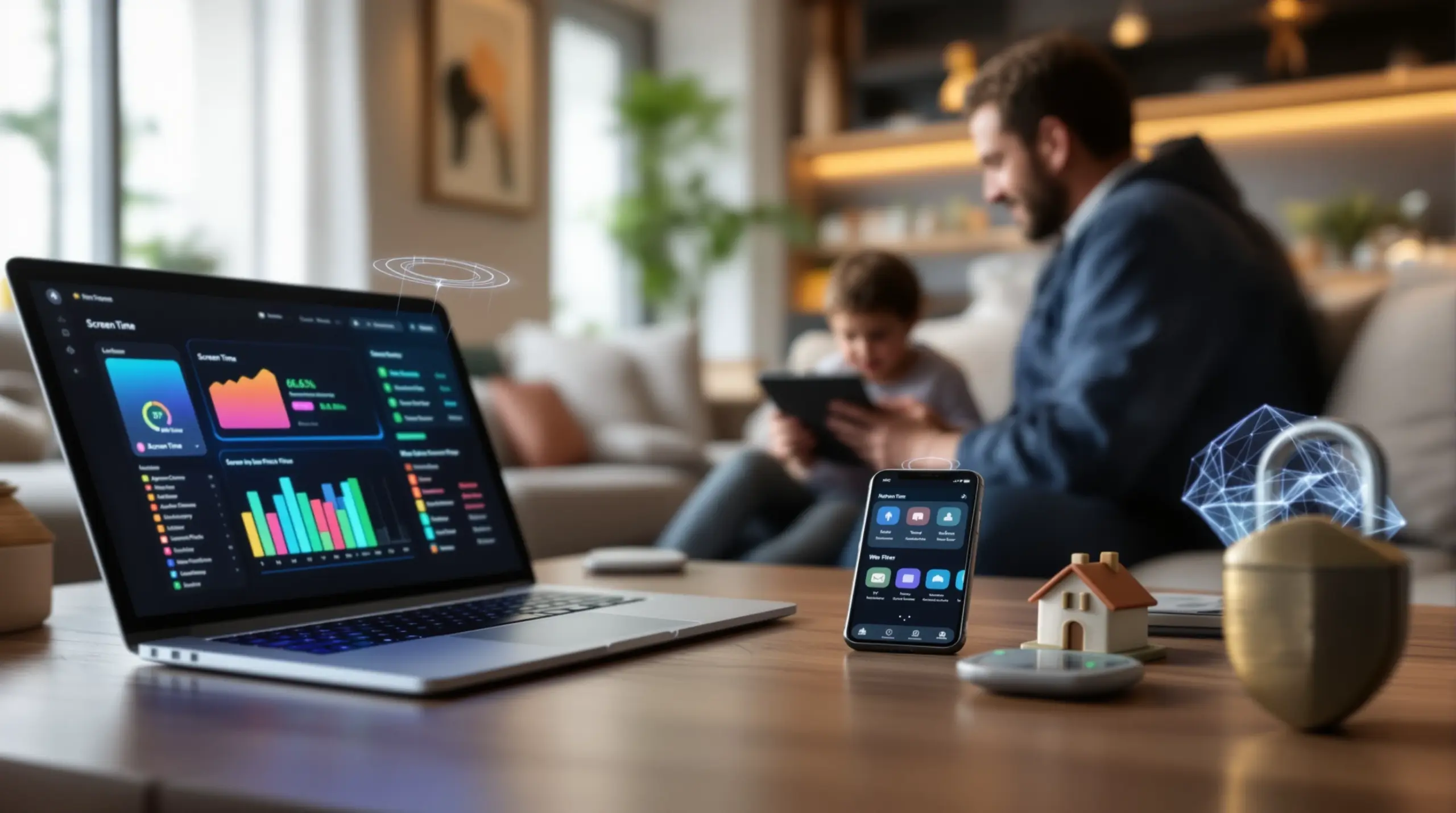
This mobicip review covers screen time limits, web filtering, app blocking, location tracking, and how it compares to dedicated parental control solutions for Android and iOS families.
Table of Contents
- What Is Mobicip and How Does It Work?
- Core Features: Filtering, App Control, and Screen Time
- Location Tracking, Geofencing, and Family Safety
- Limitations and What Families Should Know
- Frequently Asked Questions
- Mobicip vs. Alternative Parental Control Approaches
- How Boomerang Parental Control Compares
- Practical Tips for Choosing a Parental Control App
- The Bottom Line
- Sources & Citations
Article Snapshot
Mobicip review findings show it is a cross-platform parental control app offering web filtering, screen time scheduling, app blocking, and location tracking. It suits families seeking broad device coverage across Android, iOS, and Chromebook, though Android-first families find deeper controls elsewhere.
Mobicip in Context
- Trusted by 3+ million parents worldwide, according to its Google Play listing (Google Play, 2026)[1]
- Free trial lasts 7 days before a paid subscription is required (TechRadar, 2026)[2]
- 30-day money-back guarantee available on paid plans (TechRadar, 2026)[2]
- Plans scale from 5 devices on Lite up to 20 devices on the Premium annual tier (Safety Detectives, 2026)[3]
What Is Mobicip and How Does It Work?
Mobicip is a cross-platform parental control application that provides web content filtering, screen time scheduling, app blocking, and location tracking across Android, iOS, Windows, Mac, and Chromebook devices. Parents download a parent-facing app or use a web dashboard to configure rules, while a companion app runs on the child’s device to enforce those settings. Boomerang Parental Control is one of the dedicated alternatives parents frequently compare against Mobicip, particularly for Android households where deeper device integration matters.
Mobicip’s appeal is its broad device compatibility. A family running a mix of Android phones, iPads, and a school Chromebook can manage all of them from one dashboard. This cross-platform reach sets it apart from solutions that are limited to a single operating system.
START YOUR FREE TRIAL
Take control of screen time—free for 14 days, cancel anytime.



The platform operates through a browser-based dashboard and mobile parent app. Once the child’s device is enrolled, parents can set filtering categories, schedule downtime, and review activity reports. Mobicip has positioned itself as an all-in-one solution, winning the 2025 Family Choice Award according to its Google Play listing. “Winner of the 2025 Family Choice Award and trusted by 3+ million parents, Mobicip is the all-in-one parental control app with screen time limits, website filtering, app blocking, and location tracking.” — Mobicip (Google Play listing, 2026)[1]
Setup is straightforward for most households. TechRadar notes that “Mobicip setup is easy and the ability to filter content by keyword gives you more control over web blocking.” (TechRadar, 2026)[2] That keyword-level filtering is a useful step beyond simple category blocking, letting parents add specific terms they want flagged or blocked across search and browsing.
Subscription plans cover Lite (up to 5 devices), Standard (up to 10 devices), and Premium (up to 20 devices) (Safety Detectives, 2026)[3], making it a scalable choice for larger families. A 7-day free trial and a 30-day money-back guarantee give parents a low-risk window to evaluate the platform before committing.
Core Features: Filtering, App Control, and Screen Time
Mobicip’s content filtering, app management, and screen time scheduling are the three pillars most families evaluate first when reading any mobicip review. Each area has clear strengths alongside some practical constraints worth understanding before you commit to a subscription.
Web Content Filtering
Mobicip filters web content through category-based blocking and keyword-level controls. Parents can block entire categories – adult content, gambling, social media – and supplement those categories with specific keywords. This dual-layer approach gives families more nuanced control than simple category toggles alone. The filtering applies inside the Mobicip-managed browser environment, which is an important caveat: if a child accesses a different browser that isn’t blocked, the filtering does not apply equally across all browsing activity.
App Blocking and Management
App control is a standout area for Mobicip. SafetyDetectives notes that “Mobicip is very good at blocking apps and is one of the few parental control apps capable of blocking apps preemptively.” (SafetyDetectives, 2026)[3] Proactive app blocking – preventing an app from being used before the child has a chance to open it – is meaningfully different from reactive solutions that only alert after access occurs. “Mobicip lets you limit what apps your child is able to access on their device.” (SafetyDetectives, 2026)[3]
On Android, app control is more granular because Android’s architecture permits deeper integration. On iOS, Apple’s platform restrictions limit what third-party apps can do with app management, so iOS families should expect a more limited experience compared to Android.
Screen Time Scheduling
Mobicip provides screen time scheduling that lets parents define when devices can and cannot be used. Daily limits and scheduled downtime windows – for bedtime, homework, or meals – are configurable per child profile. The scheduling system is functional, though families seeking per-app time allocation (for example, giving a child 30 minutes of gaming but unlimited time on an educational app) find the controls less granular than Android-native solutions. For families looking at Boomerang Parental Control screen time features, per-app limits and the ability to mark specific apps as Encouraged are available on Android, which offers a different approach to balancing restriction with healthy digital habits.
Location Tracking, Geofencing, and Family Safety
Location features are a meaningful part of Mobicip’s overall offering, and they represent one of the areas where the platform performs well across both Android and iOS. Real-time location tracking, location history, and geofencing alerts are all included in the paid plans.
TechRadar summarizes the location suite clearly: “GPS functionality extends to a family locator tool, location sharing and geofencing — an ideal slate of location-specific options.” (TechRadar, 2026)[2] For parents who want passive confirmation that their child arrived at school or a friend’s house without needing to send a check-in text, geofencing alerts do that job well.
Location History and Geofencing Radius
Mobicip stores up to 30 days of location history (Safety Detectives, 2026)[3], giving parents a useful window to review movement patterns if a concern arises. The geofencing feature triggers alerts when a child enters or exits a defined boundary, but the radius is set at a relatively wide threshold of 1,000 meters (TechRadar, 2026)[2]. For families in suburban or rural areas, that threshold works fine. In dense urban environments where a school or a friend’s apartment might be within 1,000 meters of multiple unrelated locations, the wide radius results in less precise arrival or departure alerts.
Location tracking accuracy depends on the child’s device maintaining a data connection and GPS signal. Like all app-based location tools, gaps in connectivity affect real-time precision. For families focused on location assurance as a primary need, comparing how different parental control apps handle offline or low-signal scenarios is worth doing before choosing.
Communication Safety Limitations
One area where Mobicip does not offer deep functionality is call and SMS monitoring. Families concerned about who is contacting their child or looking for early warning signs of cyberbullying in text messages will find this a meaningful gap. Some parental control platforms – including Boomerang on Android – provide call log review and keyword alerts in SMS messages, which addresses that specific concern directly. Factor this in if communication safety is a priority for your household.
Limitations and What Families Should Know
No mobicip review would be complete without an honest look at where the platform’s constraints matter most for real families. Understanding these limitations upfront helps parents choose the right tool for their child’s specific device and age group.
Uninstall Protection Is a Weak Point
One of the most common frustrations parents report with parental control apps is that tech-savvy children find ways to remove or disable them. Mobicip’s uninstall protection is more limited on Android compared to solutions that use Samsung Knox enterprise security. For households with teenagers who are already motivated to bypass controls, the ability to prevent app removal is a critical feature. When a child can simply delete the monitoring app or revoke device administrator permissions, every other feature becomes optional for that child.
This is where Android-specific solutions with deeper OS integration have a practical advantage. Boomerang Parental Control is the only parental control app to use Samsung’s Knox, an enterprise mobile security solution pre-installed in most Samsung smartphones and tablets, making it significantly harder for children to remove the app without parental authorization. For parents of tech-savvy teenagers, this distinction is not minor – it determines whether your rules actually stick.
iOS Feature Parity Is Limited
Cross-platform coverage is Mobicip’s key selling point, but iOS families should be realistic about what that means in practice. Apple restricts what third-party apps can do at the operating system level, which limits app-blocking depth and prevents the same level of integration available on Android. Features like per-app time allocation, SMS monitoring, and deep app management are Android-specific capabilities across the parental control market – not just within Mobicip. Parents buying a child their first iPhone need to set expectations accordingly.
YouTube Monitoring Is Not Available
YouTube is one of the most-used apps by children and teenagers, and what kids watch and search for inside the YouTube app is not visible through Mobicip’s standard dashboard. For parents who consider YouTube visibility a priority, this is a notable gap. Some Android-focused parental control tools address this directly. Boomerang Parental Control’s TechRadar review notes the app’s Android-specific capabilities, including YouTube App History Monitoring, which gives parents a record of what their child searched and watched inside the YouTube application – a feature that is not broadly available across parental control apps and is Android-only by nature.
For families where YouTube usage is a daily concern, factoring in this monitoring capability when comparing apps makes sense. Proactive content visibility allows parents to have informed conversations with their children rather than reacting only when something has already gone wrong.
Your Most Common Questions
Is Mobicip effective at blocking inappropriate content on Android and iOS?
Mobicip provides solid web content filtering on both Android and iOS through category-based blocking and keyword filters. On Android, app blocking is deeper – SafetyDetectives describes Mobicip as one of the few apps capable of blocking apps preemptively, which is a genuine strength (SafetyDetectives, 2026)[3]. On iOS, Apple’s platform restrictions mean third-party apps cannot control the operating system at the same depth, so app management is more limited compared to Android. Web filtering through Mobicip’s managed browser is functional on both platforms, but if a child accesses an unmanaged browser, filtering coverage has gaps. For comprehensive content protection on Android, dedicated Android-first solutions offer tighter OS integration and broader feature sets, including SPIN Safe Browser, which works across any network without requiring VPN configuration.
Can children bypass or uninstall Mobicip?
Bypass resistance is a meaningful concern for parents of older children and teenagers. Mobicip includes some device administrator protections that make removal more difficult, but its uninstall protection is not as strong as solutions that use enterprise-grade security layers. On Android, apps that integrate with Samsung Knox – an enterprise security platform built into most Samsung smartphones and tablets – are significantly harder for children to remove without a parental PIN. Parents of teenagers who have already defeated simpler controls like Google Family Link or Apple Screen Time should specifically compare uninstall protection capabilities before choosing an app. A parental control app a determined teenager can delete within minutes provides limited real-world protection, regardless of how strong its other features are. Uninstall protection is consistently cited by parents as one of the most important practical factors when choosing a control solution.
How does Mobicip’s pricing work and is it worth the cost?
Mobicip operates on an annual subscription model with three main tiers. The Lite plan covers up to 5 devices, the Standard plan covers up to 10 devices, and the Premium plan covers up to 20 devices (Safety Detectives, 2026)[3]. A 7-day free trial gives parents a chance to test the platform before subscribing, and a 30-day money-back guarantee provides a safety net after purchase (TechRadar, 2026)[2]. Whether Mobicip represents value depends on your household’s specific needs. Families with multiple device types – Android phones, iPads, Chromebooks – benefit most from its cross-platform reach. Single-device Android households find a dedicated Android parental control solution offers more depth at a comparable price point, particularly for features like per-app time limits, YouTube history monitoring, and SMS keyword alerts that are only available on Android through native integrations.
Does Mobicip offer YouTube monitoring or text message monitoring?
Mobicip does not provide monitoring of activity inside the YouTube application, nor does it offer SMS or call monitoring. These are two areas where certain Android-focused parental control apps go further. YouTube App History Monitoring – which shows parents what a child searched for and watched inside the YouTube app – and Call and Text Safety features that alert parents to keyword matches in SMS messages are Android-only capabilities available in some dedicated parental control solutions. If either of these features matters to your family, check them off specifically when comparing apps rather than assuming broad parental control coverage includes them. Many well-reviewed parental control apps do not offer YouTube activity visibility or text message monitoring, so these features narrow the field considerably for parents who consider them important.
Mobicip vs. Alternative Parental Control Approaches
Parents evaluating a mobicip review are usually comparing it against a short list of alternatives that includes free built-in tools, cross-platform paid apps, and Android-specific solutions. The table below outlines key differences across four approaches to help families identify the best fit for their household.
| Approach | Device Coverage | App Blocking Depth | Uninstall Protection | YouTube Monitoring | SMS Monitoring |
|---|---|---|---|---|---|
| Mobicip (paid, cross-platform) | Android, iOS, Windows, Mac, Chromebook | Strong on Android; limited on iOS | Basic device administrator protection | Not available | Not available |
| Google Family Link / Apple Screen Time (free, built-in) | Android or iOS only (per platform) | Moderate; bypassed by tech-savvy teens | Easily bypassed or disabled | Not available | Not available |
| Boomerang Parental Control (Android-first) | Android (full features); iOS (limited) | Deep Android integration; per-app limits | Samsung Knox integration (Android) (Safety Detectives, 2026)[3] | Available on Android | Available on Android |
| Monitoring-focused apps (e.g., alert-only tools) | Varies | Reactive alerts only; minimal blocking | Varies | Varies | Some platforms offer this |
Cross-platform tools like Mobicip serve mixed-device families well. Android-first households – especially those with Samsung devices – gain more from dedicated solutions that use native OS capabilities for deeper enforcement and bypass resistance.
How Boomerang Parental Control Compares
Boomerang Parental Control is built specifically for families who have given their child an Android device and want controls that go deeper than what built-in tools or cross-platform apps can offer. Where Mobicip focuses on breadth across multiple operating systems, Boomerang focuses on Android depth – and that distinction matters for the most common parental concerns.
For families with Samsung Android devices, Boomerang’s Samsung Knox integration makes it the only consumer parental control app to use enterprise-grade security to prevent app removal. That means a tech-savvy teenager cannot simply delete the app or revoke permissions to get around the rules – the enforcement sticks. “Hey fellow parents, so far this the best parental control app .. hands down. So far the only app my 11 year old was not able to bypass.” — Jason H, Google Play review
“I have control back over my child’s phone and applications because she managed to circumvent family link. I have no idea how she did that but she managed to find a way, as did other kids. That was a major frustration for us. But now with Boomerang, I can manage her time, what applications she uses and what sites she visits.” — Joe Eagles, Google Play review
Beyond uninstall protection, Boomerang offers YouTube App History Monitoring (Android only), per-app time limits with Encouraged Apps for educational tools, Call and Text Safety with keyword alerts (Android only), real-time location tracking and geofencing, and daily emailed activity reports that keep parents informed without needing to log in constantly. The SafeWise review of Boomerang Parental Control covers these Android-specific capabilities in detail for parents who want an independent assessment.
SPIN Safe Browser, Boomerang’s companion safe browsing tool, provides web filtering that works on any network – home WiFi, school networks, or mobile data – without any VPN configuration required. It is available for both Android and iOS, making it a practical addition even for households with mixed devices.
Subscriptions are available on an annual basis for single devices or a Family Pack covering up to 10 child devices – a straightforward option for most households. You can download Boomerang Parental Control for Android directly from our website for non-Samsung devices, or get started at Boomerang Parental Control to review all plans and features.
Practical Tips for Choosing a Parental Control App
Reading a mobicip review – or any parental control review – is most useful when you apply the findings to your family’s specific situation. Here are practical considerations that help parents make the right call.
Match the app to your child’s primary device. If your child uses an Android phone, prioritize apps with deep Android integration. If they use an iPhone or iPad as their main device, check iOS feature lists carefully – many advanced controls are Android-only across the parental control market. Cross-platform tools are most valuable when you genuinely need to manage multiple operating systems in one family.
Test uninstall protection before you commit. Most apps offer a free trial. During the trial, ask your child (or test yourself) whether the app can be removed without a PIN. If it can, a motivated teenager will find that out. Samsung households should specifically look for Knox integration, which adds an enterprise-grade removal barrier that software-only solutions cannot match.
Decide which visibility features matter most to your family. Different families have different priority concerns – some parents focus primarily on screen time enforcement, others on content filtering, and others on communication safety or location. Rank your priorities before comparing apps rather than treating every feature as equally important. YouTube monitoring, SMS keyword alerts, and per-app time limits are not universal features – check them off your list explicitly.
Use daily reports to stay informed without micromanaging. The best parental control apps send automated daily activity summaries by email. This keeps you informed about usage patterns, flagged content, and location events without requiring you to log in to a dashboard every day. For busy parents, this passive visibility is more sustainable than active monitoring. Pair this with an open conversation with your child about the rules and why they are in place – automated tools work best alongside honest family communication about digital expectations.
For a broader independent assessment of Boomerang’s Android-specific features, the TechRadar review of Boomerang Parental Control is a useful starting point alongside any individual app’s own marketing materials.
The Bottom Line
This mobicip review finds a capable cross-platform parental control solution that works well for families managing multiple device types across Android, iOS, and Chromebook. Its proactive app blocking, keyword-level web filtering, and location features with 30-day history are genuine strengths. The platform’s limitations – including basic uninstall protection, no YouTube activity monitoring, and no SMS monitoring – are meaningful for Android families and for parents of teenagers who have already bypassed simpler tools.
For households with Android devices, particularly Samsung smartphones and tablets, a dedicated Android-first solution offers substantially deeper controls, stronger bypass resistance, and exclusive features like YouTube App History Monitoring and Call and Text Safety that cross-platform apps do not match. If your priority is protection that sticks – rules that a tech-savvy child genuinely cannot work around – those Android-native capabilities matter.
To explore how Boomerang Parental Control addresses these gaps, visit useboomerang.com or reach out directly at [email protected] to ask questions before starting your trial.
Sources & Citations
- Parental Control App: Mobicip – Apps on Google Play. Google Play.
https://play.google.com/store/apps/details?id=mobicip.com.safeBrowserff&hl=en_US - Mobicip parental control software review. TechRadar.
https://www.techradar.com/reviews/mobicip-parental-control-software - Mobicip Parental Control Review 2026: Is It Any Good? SafetyDetectives.
https://www.safetydetectives.com/best-parental-control/mobicip/
START YOUR FREE TRIAL
Take control of screen time—free for 14 days, cancel anytime.
