
12
Dec
2025
Parental YouTube Controls: Keep Kids Safe Online
December 12, 2025
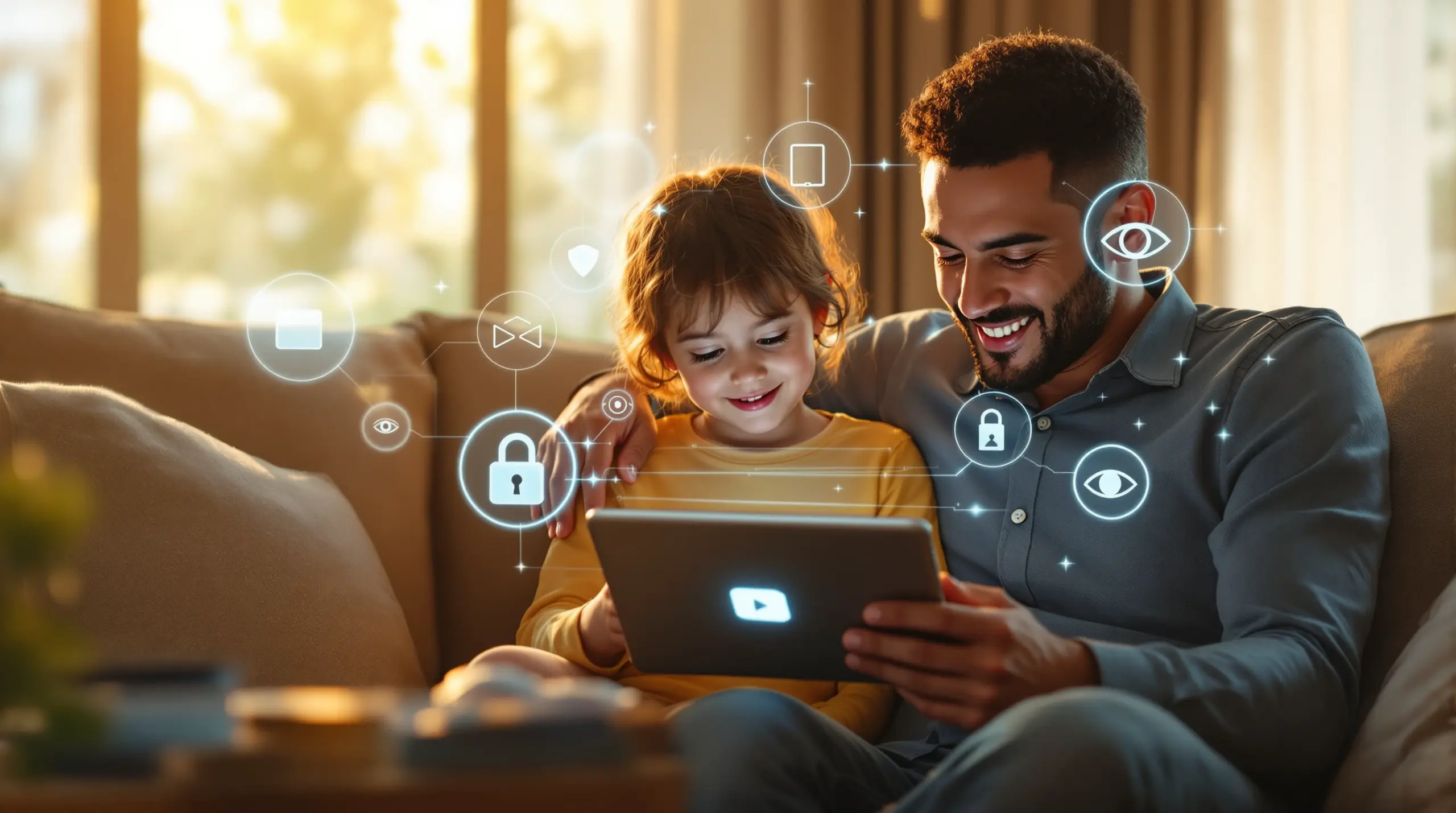
Parental YouTube controls help families manage what children watch, how long they spend on the platform, and what content the recommendation algorithm surfaces – essential knowledge for every connected household.
Table of Contents
- What Is Parental YouTube Control?
- Why YouTube Monitoring Matters for Families
- How to Implement YouTube Controls on Android and iOS
- Beyond Blocking: Building Healthy YouTube Habits
- Frequently Asked Questions
- Parental YouTube Control Approaches Compared
- How Boomerang Parental Control Helps
- Practical Tips for Managing YouTube at Home
- The Bottom Line
- Sources & Citations
Article Snapshot
Parental YouTube control is the practice of monitoring, limiting, and filtering a child’s YouTube viewing to ensure age-appropriate content and healthy screen time. Effective oversight combines app-level tools, device controls, and open family conversations about responsible viewing habits.
Quick Stats: parental youtube
- 80% of parents with a child age 11 or younger say their child watches videos on YouTube (Pew Research Center, 2020)[1]
- 53% of those parents report their child watches YouTube daily (Pew Research Center, 2020)[1]
- 46% of parents say their child age 11 or younger has encountered inappropriate videos on YouTube (Pew Research Center, 2020)[1]
- U.S. children spend an average of 77 minutes per day on YouTube (The Social Shepherd, 2026)[2]
What Is Parental YouTube Control?
Parental YouTube control refers to any combination of tools, settings, or app-level features that allow caregivers to oversee, restrict, or review a child’s activity on YouTube. This goes well beyond simply taking the phone away at bedtime. It includes filtering the content algorithm surfaces, reviewing search and watch history, setting daily time limits, and blocking access to the platform entirely during homework or sleep hours. Boomerang Parental Control, available for Android and iOS devices, gives families practical tools to manage exactly this kind of oversight from a parent’s phone – without constant manual policing.
YouTube is not a passive library. Its recommendation engine continuously surfaces new videos based on watch history, and that system does not apply a reliable age filter by default. A child who searches for a favourite cartoon can find themselves watching conspiracy content, age-inappropriate challenges, or disturbing videos within a few clicks. This is why platform-native settings alone – such as YouTube Kids or Restricted Mode – are widely considered insufficient by parents who have seen them fail in practice.
START YOUR FREE TRIAL
Take control of screen time—free for 14 days, cancel anytime.



Effective parental YouTube management combines three layers: platform-level settings (Restricted Mode, YouTube Kids), device-level screen time scheduling, and third-party app oversight that captures viewing history and enforces time boundaries the child cannot override. The third layer is where dedicated parental control tools fill the gap that free built-in options leave open.
For families using Android devices, this oversight extends to visibility into the standard YouTube app itself – not just the YouTube Kids version – which is where most older children and teenagers spend their time. Understanding what those controls look like in practice is the starting point for keeping kids safer on the platform.
Why YouTube Monitoring Matters for Families
The scale of children’s YouTube use makes platform oversight one of the most important digital parenting decisions a family can make. According to Pew Research Center Analysts: “80% of all parents with a child age 11 or younger say their child ever watches videos on YouTube, with 53% reporting that their child does this daily.”[1] That daily exposure, averaging 77 minutes per day for U.S. children (The Social Shepherd, 2026)[2], creates significant opportunity for children to encounter content that was not intended for their age group.
The risk is well-documented. Pew Research Center Analysts noted that “More than four-in-ten parents (46%) say their child age 11 or younger who uses this platform has encountered videos on YouTube that were inappropriate for their age.”[1] That figure climbs to 56% among parents of children aged 5 to 11 (Pew Research Center, 2020)[1], meaning the risk intensifies as children become more independent viewers with the ability to search and navigate on their own.
The recommendation algorithm is a central concern. Pew Research Center Analysts found that “Some 65% of parents at least somewhat concerned about the types of videos being recommended to their children on YouTube.”[1] This concern is grounded in how the algorithm works: it optimises for watch time, not age-appropriateness. A child who watches one borderline video is more likely to be served similar content in the next autoplay cycle, creating a gradual drift toward material parents would not approve of if they were watching alongside their child.
Beyond inappropriate content, excessive YouTube use contributes to the screen time conflict that many families experience daily. When a child is deep into a video session, being told to stop triggers resistance or argument. Automated controls that enforce time limits without a parent having to intervene directly remove that friction. Monitoring YouTube history also opens the door to proactive conversations – a parent who sees what topics their child is searching for addresses concerns before they become serious problems, rather than discovering an issue after the fact. You can read more about how independent reviewers assess parental control tools to understand what families are looking for in YouTube management features.
How to Implement YouTube Controls on Android and iOS
Setting up effective parental YouTube oversight requires a layered approach that addresses both what children watch and how long they watch it, with controls that hold up even when a child is motivated to get around them.
Platform-Level Settings: YouTube Kids and Restricted Mode
YouTube offers two primary built-in tools for families. YouTube Kids is a separate app designed for younger children with curated content and parental approval workflows. For older children using the standard YouTube app, Restricted Mode filters out content flagged as inappropriate, though it is not foolproof and a user who knows where to look in the settings menu can disable it. These platform settings are a useful first layer but should not be treated as a complete solution.
Device-Level Screen Time Scheduling
Both Android and iOS provide native screen time tools. Android’s Digital Wellbeing feature allows parents to set app timers for YouTube, while iOS Screen Time restricts app access by category or specific app. The significant limitation with both is that a determined child finds ways to reset timers, switch to a browser to access YouTube directly, or simply use a sibling’s device. Native controls also provide no visibility into what was actually watched – they manage time but not content insight.
Third-Party Parental Control Apps for Deeper Oversight
Third-party apps provide the most reliable combination of time enforcement and content visibility. On Android, dedicated parental control tools access YouTube app history directly, giving parents a record of searches and watched videos within the standard app – not just the Kids version. This is the visibility layer that built-in tools cannot provide. Pairing this with uninstall protection ensures that the monitoring tool itself cannot be removed by a tech-savvy child who wants to avoid oversight. For families using the SPIN Safe Browser – Safe web browsing for Boomerang Parental Control, web-based YouTube access through a browser is also filtered, adding another layer without requiring router configuration or a VPN.
iOS support for these deeper features is more limited by Apple’s platform architecture. On iOS devices, screen time scheduling and location tracking remain available, but features like YouTube app history monitoring and per-app time limits tied to specific apps are Android-only capabilities. Families with iOS child devices should account for this when choosing their control strategy.
Beyond Blocking: Building Healthy YouTube Habits
Restricting YouTube access entirely is rarely a sustainable long-term strategy, and most child development professionals agree that guided use is more effective than outright prohibition for building lasting digital habits. The goal of parental YouTube oversight should be to move from pure restriction toward structured, age-appropriate engagement that teaches children to self-regulate over time.
One practical framework is to use app time limits that are firm but not punitive. Setting a daily YouTube allowance – say, 45 minutes for a primary schooler – and enforcing it automatically removes the daily negotiation without making YouTube feel like a forbidden topic. When the time limit is hit, the app locks without parental intervention. This approach treats the control tool as the neutral enforcer, keeping the parent out of the role of “screen time police” and preserving the parent-child relationship for more important conversations.
Pairing time limits with encouraged app designations reinforces positive habits. Educational content – school portal apps, reading tools, science channels on YouTube Kids – is exempted from the daily entertainment limit, sending a clear signal to children about which types of screen time the family values. This is meaningfully different from blanket restriction, and children respond better to a system that rewards constructive use than one that punishes all device time equally.
Visibility into YouTube history creates another valuable opportunity. When a parent sees that their child has been searching for a topic that raises concern – anxiety-related content, videos about self-harm, or contact with strangers – they start a conversation from a place of knowledge rather than suspicion. This transforms the monitoring tool from a surveillance device into a communication prompt. Independent reviews of parental control tools frequently highlight this visibility feature as one of the most valued by parents who want to stay connected to their child’s digital life without reading every message or watching every video themselves.
The long-term aim is to gradually loosen controls as children demonstrate responsible choices, building trust through a track record rather than through assumption. Starting with firm limits and a clear visibility framework gives families the data they need to make those trust decisions with confidence rather than guesswork.
Your Most Common Questions
Can I see what my child watches on the regular YouTube app, not just YouTube Kids?
Yes, but only on Android devices using a dedicated parental control app that supports YouTube app history monitoring. The standard YouTube app does not share watch history with Apple’s Screen Time or Google’s Family Link in a parent-readable format. On Android, tools like Boomerang Parental Control provide visibility into what your child searches for and watches within the main YouTube application – the app most older children use, not the Kids version. This feature is Android-only due to platform-level differences in how iOS handles third-party app oversight. If your child uses an Android phone or tablet, this is one of the most practical visibility tools available to you. If your household uses iOS devices for your children, your options are more limited and primarily involve platform-level Restricted Mode and Screen Time scheduling rather than detailed history review.
Is YouTube Kids safe enough on its own, or do I need additional controls?
YouTube Kids is a useful starting point for younger children, but it has well-documented limitations. Videos are algorithmically filtered rather than individually reviewed, and inappropriate content has slipped through on multiple occasions. More importantly, YouTube Kids does not enforce screen time limits on its own – it relies on the parent to set a timer within the app, which a child ignores if left unsupervised. For younger children aged four to seven, YouTube Kids combined with device-level screen time scheduling provides a reasonable layer of protection. For children aged eight and older who are using the standard YouTube app, you need a third-party parental control solution that enforces time limits the child cannot override and provides visibility into what they are actually watching. YouTube Kids alone is not sufficient for families with school-aged children who have independent device access.
What happens if my child uses a browser to access YouTube and bypass the app controls?
This is one of the most common workarounds children use, and it is why app-only controls are not enough. If you block or limit the YouTube app but leave a standard web browser unrestricted, your child opens YouTube in Chrome, Safari, or any other browser and accesses the same content without any of the app-level restrictions applying. The solution is to pair app-level YouTube controls with web filtering that blocks YouTube via browser when app time is up, or to replace the default browser with a filtered safe browser. The SPIN Safe Browser, which integrates with Boomerang Parental Control, handles this by enforcing content filtering and SafeSearch on any network – including mobile data and school wifi – without requiring a VPN or router configuration. When screen time limits are hit, the browser locks alongside the app, closing the browser workaround entirely.
How do I stop my child from deleting the parental control app to regain YouTube access?
Uninstall protection is the feature you need, and its effectiveness varies significantly between tools. Basic parental control apps are deleted like any other app, which is why many tech-savvy children simply remove them when they want unrestricted access. More strong solutions use device administrator permissions on Android to prevent removal without a parental PIN. On Samsung Android devices, Boomerang Parental Control is the only parental control app to use Samsung’s Knox, an enterprise mobile security solution pre-installed on most Samsung smartphones and tablets. Knox integration makes the app exceptionally difficult to remove or bypass, even for teenagers who are motivated and technically capable. On iOS, uninstall protection works differently – Apple’s platform architecture limits what third-party apps do, so iOS protection is primarily notification-based, alerting you if the app is removed rather than preventing it. For families where bypass is a real concern, an Android device with Knox-capable Samsung hardware provides the strongest available protection.
Parental YouTube Control Approaches Compared
Not all YouTube control strategies offer the same level of protection. The table below compares four common approaches across the features that matter most to parents managing a child’s YouTube access on a mobile device.
| Approach | Watch History Visibility | Time Limit Enforcement | Bypass Resistance | Browser Workaround Protection |
|---|---|---|---|---|
| YouTube Kids App Only | No | In-app timer only (child ignores) | Low | None |
| Google Family Link / Apple Screen Time | No | Yes, but workarounds exist | Low to Medium | Partial |
| Third-Party Parental Control (iOS) | No (iOS limitation) | Yes, scheduled downtime | Notification-only on iOS | Partial with safe browser |
| Third-Party Parental Control (Android) with Safe Browser | Yes (Android only)[1] | Yes, automated daily limits | High (Knox on Samsung) | Full with integrated safe browser |
How Boomerang Parental Control Helps
Boomerang Parental Control – Taking the battle out of screen time for Android and iOS was built specifically to address the gaps that free tools leave open, with Android-first features that go deeper than platform-native controls.
For families managing YouTube access on Android devices, Boomerang’s YouTube App History Monitoring gives you direct visibility into what your child searches for and watches within the standard YouTube application – not just YouTube Kids. This is the feature most parents ask for and the one most competitors cannot deliver. You see the search terms and watch history in your parent dashboard, giving you the information you need to have informed conversations rather than guesswork about what your child is consuming online.
Screen time management is handled through Boomerang Parental Control – screen time features that automate daily limits and bedtime scheduling. When the daily YouTube allowance is reached, the app locks – no negotiation, no argument, no manual intervention from you. Educational apps are designated as Encouraged Apps, meaning they bypass the entertainment time limit. This guides children toward balanced use rather than punishing all screen time equally.
Uninstall protection, including Samsung Knox integration on supported Samsung Android devices, ensures that a tech-savvy child cannot simply delete the app to regain unrestricted YouTube access. On iOS, features are more limited by Apple’s platform – iOS support includes scheduled screen time, location tracking, and tamper notifications, but the deeper Android features like YouTube history monitoring and per-app controls are not available on iOS child devices.
Families who want to explore the full feature set visit the Sideload download page for Android devices for installation on non-Samsung Android devices that brings the complete feature set including call and text safety alongside app removal protection.
“Hey fellow parents, So far this the best parental control app .. hands down. So far the only app my 11 year old was not able to bypass. Big Shout out to developers for making such a great app.” – Jason H, Google Play review
“This is a great application! I have control back over my child’s phone and applications because she managed to circumvent family link. I have no idea how she did that but she managed to find a way, as did other kids. That was a major frustration for us. But now with Boomerang, I can manage her time, what applications she uses and what sites she visits.” – Joe Eagles, Google Play review
Get in touch with the Boomerang team at [email protected] or submit a request through the support portal to find out which plan fits your family’s devices and needs.
Practical Tips for Managing YouTube at Home
Start with history visibility before you start with restrictions. Spend a week reviewing what your child actually watches on YouTube before changing any settings. This gives you a realistic picture of their habits and lets you have a grounded conversation about expectations rather than imposing rules based on assumptions.
Set time limits that are firm but reasonable. A daily YouTube allowance that feels fair to your child is more sustainable than a strict block that generates constant conflict. Use automated enforcement so the app becomes the rule-maker, not you. When the time is up, it is the phone’s decision – not yours – which removes you from the daily argument.
Replace the default browser with a filtered alternative on your child’s device. Leaving Chrome or Safari unrestricted while blocking the YouTube app is a gap children find quickly. A safe browser with built-in content filtering closes that workaround on any network, including at school or a friend’s house.
Use geofencing alongside YouTube controls for a more complete safety picture. Knowing your child arrived at school is connected to knowing they are not watching YouTube during class. Location alerts and screen time scheduling work together as part of a broader digital safety strategy.
Review YouTube history with your child, not just privately. Sharing what you see – and explaining why you are monitoring – builds transparency and teaches children that online activity is not anonymous. This conversation, repeated over time, does more to build healthy habits than any technical control alone.
Gradually loosen controls as your child demonstrates responsible choices. The goal is not permanent restriction but guided independence. Children who understand why limits exist and see those limits ease as they earn trust are more likely to develop genuine self-regulation than those who experience controls as arbitrary punishment they need to escape.
The Bottom Line
Parental YouTube control is one of the most practical steps you can take to protect your child’s online experience and reduce daily household conflict over screen time. With 46% of parents of children under 12 reporting their child has already encountered inappropriate YouTube content (Pew Research Center, 2020)[1], waiting for a problem to appear is not a strategy.
The most effective approach layers platform settings, automated time enforcement, and visibility tools that give you insight into what your child is actually watching – especially on Android, where third-party tools access the standard YouTube app directly. Free built-in controls have real gaps that motivated children find and exploit.
If you are ready to set up YouTube monitoring and screen time management that holds up, visit Boomerang Parental Control or reach out to the team at [email protected] to get started today.
Sources & Citations
- Parental views about YouTube. Pew Research Center.
https://www.pewresearch.org/internet/2020/07/28/parental-views-about-youtube/ - 23 Essential YouTube Statistics You Need to Know in 2026. The Social Shepherd.
https://thesocialshepherd.com/blog/youtube-statistics
START YOUR FREE TRIAL
Take control of screen time—free for 14 days, cancel anytime.
