
07
Jul
2026
Is Social Media Bad for Teenager Mental Health?
July 7, 2026
Social media is bad for teenager mental health in measurable ways – from disrupted sleep and cyberbullying exposure to anxiety and compulsive use patterns. Here’s what the research says and what parents can do.
Table of Contents
- What the Research Says About Social Media and Teen Mental Health
- How Social Media Harms Teenagers Day to Day
- Warning Signs Your Teen’s Social Media Use Has Become Problematic
- What Parents Can Do When Social Media Is Bad for Teenager Well-Being
- Frequently Asked Questions
- Approaches to Managing Teen Social Media Use
- How Boomerang Parental Control Supports Healthier Digital Habits
- Practical Tips for Parents
- The Bottom Line
- Sources & Citations
Article Snapshot
Social media is bad for teenager well-being when use becomes excessive or compulsive, linking to poor sleep, anxiety, cyberbullying, and disrupted focus. Understanding the specific risks – and responding with consistent digital boundaries – gives parents a clear path to protecting their teen’s mental and physical health.
Quick Stats: social media is bad for teenager
- 95% of U.S. teens ages 13-17 report using at least one social media platform (National Center for Biotechnology Information / NIH, 2023).[1]
- 11% of adolescents show signs of problematic social media behavior – up 4 percentage points since 2018 (World Health Organization Regional Office for Europe, 2024).[2]
- For U.S. teens ages 12-15, using social media three hours per day was linked to a higher risk of mental health concerns (Mayo Clinic, 2025).[3]
- 13% of adolescent girls and 9% of adolescent boys report problematic social media use (World Health Organization Regional Office for Europe, 2024).[2]
What the Research Says About Social Media and Teen Mental Health
Social media is bad for teenager mental health when daily use crosses into compulsive, unmanaged territory – and the research from major health institutions now makes that case clearly. Boomerang Parental Control was built precisely for this reality, giving families practical tools to set boundaries before problems take hold. Understanding the evidence is the first step toward knowing what action to take.
Nearly every American teenager is on social media. A full 95% of U.S. teens ages 13-17 report using at least one platform, and more than one-third say they are on social media almost constantly (National Center for Biotechnology Information / NIH, 2023).[1] That level of exposure has drawn serious attention from the medical community.
START YOUR FREE TRIAL
Take control of screen time—free for 14 days, cancel anytime.




In 2023, U.S. Surgeon General Dr. Vivek H. Murthy stated directly: “There are ample indicators that social media can also have a profound risk of harm to the mental health and well-being of children and adolescents.” (Social Media and Youth Mental Health, 2023)[4]
The World Health Organization’s 2024 report on teens, screens, and mental health found that 11% of adolescents showed signs of problematic social media behavior, with that figure rising by 4 percentage points between 2018 and 2022 (World Health Organization Regional Office for Europe, 2024).[2] Girls are disproportionately affected: 13% of adolescent girls reported problematic use compared to 9% of boys in the same dataset.[2]
For parents of pre-teens handing their child a first smartphone, this research context matters enormously. Children who begin heavy use early – before healthy offline habits are established – face the steepest risks. The patterns that form between ages 10 and 14 carry through the teen years, which is why Boomerang Parental Control’s screen time features focus on building structure from day one rather than reacting after problems emerge.
Daily Usage Thresholds and Mental Health Links
Three hours of social media per day – an amount many teens reach before dinner – was linked to a higher risk of mental health concerns in U.S. teens ages 12-15, according to Mayo Clinic (2025).[3] That figure puts routine use well within concerning territory for millions of families. The correlation is not just about volume; it’s about what those hours displace – sleep, physical activity, homework, and face-to-face connection. Researchers consistently find that teens who scroll heavily at night experience the sharpest declines in sleep quality and emotional regulation, both of which compound over time into larger mental health challenges.
How Social Media Harms Teenagers Day to Day
The harms associated with heavy adolescent social media use fall into several overlapping categories, each of which affects family life in concrete and recognizable ways.
Sleep Disruption and Bedtime Scrolling
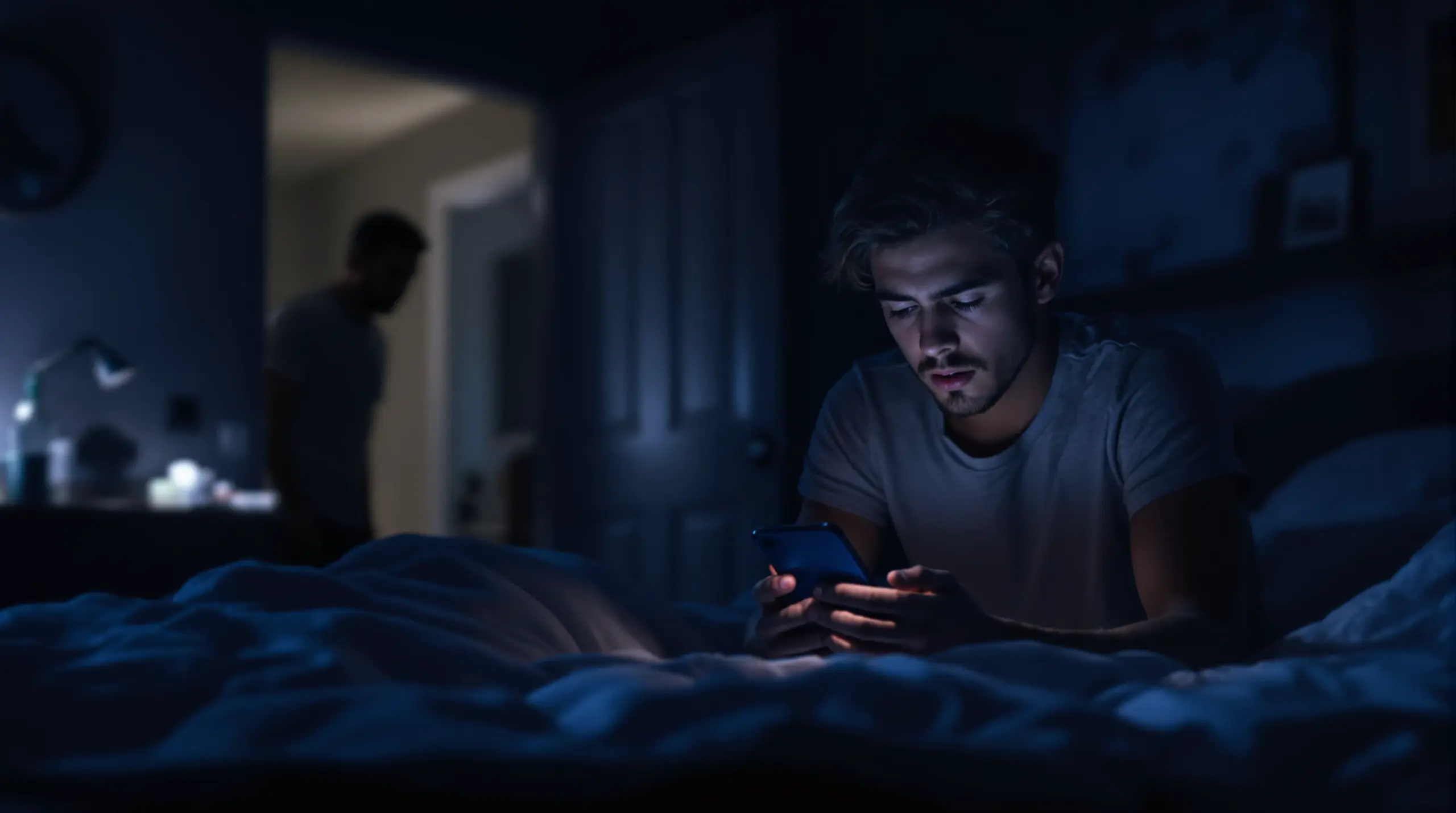
Sleep disruption is one of the most consistently documented outcomes of excessive teen social media use. The American Academy of Pediatrics notes that “sleep is negatively impacted when teens postpone bedtime so that they can continue to use social media” (The Good and Bad of Social Media: What Research Tells Us, 2025).[5] Devices in the bedroom after lights-out are the single most common driver of this pattern. Many parents find that no amount of verbal reminders solves the problem – only automated enforcement does.
Boomerang’s Scheduled Downtime feature locks the device automatically at a set bedtime, removing the device from the equation without a nightly argument. On Android devices, this works across all apps – including social media platforms – and cannot be overridden by the child.
Cyberbullying and Exposure to Harmful Content
Cyberbullying is a second major harm vector. The American Academy of Pediatrics confirms that “teens experience or witness bullying or hurtful behavior online” (2025).[5] For many teens, this exposure happens on platforms parents assume are relatively safe – comment sections, DMs, and group chats that are invisible to adults unless specific monitoring tools are in place.
Mayo Clinic’s clinical team summarizes the cumulative picture clearly: “Social media use has negative effects on some teens. It distracts from homework, exercise and family activities, disrupts sleep, and exposes some teens to cyberbullying” (Teens and social media use: What’s the impact?, 2025).[3] For families managing Android devices, Boomerang Parental Control includes Call and Text Safety monitoring that flags inappropriate keywords in SMS messages – giving parents an early warning system rather than finding out after the fact.
Social Comparison, Learning Impact, and Self-Esteem
Johns Hopkins Medicine identifies poor sleep, increased social comparisons, impact on learning, and exposure to cyberbullying and negative content as the key drawbacks of excess social media use (Social Media and Mental Health in Children and Teens, 2025).[6] Social comparison – measuring your own life against the curated highlights of peers – is particularly damaging during adolescence, when identity and self-worth are actively forming. Teens who scroll passively for extended periods consistently report lower life satisfaction than those with structured, time-limited use. This is why time limits matter not just as a safety measure, but as a genuine investment in your teen’s long-term confidence and emotional health.
The SPIN Safe Browser pairs web filtering with Boomerang’s screen time controls to limit exposure to content that fuels harmful comparison – working on any network without requiring a VPN or router changes.
Warning Signs Your Teen’s Social Media Use Has Become Problematic
Problematic social media use in teenagers follows recognizable patterns, and catching them early makes intervention far easier than waiting for a crisis point.
The World Health Organization defines problematic social media behavior as struggling to control use and experiencing negative consequences as a result (World Health Organization Regional Office for Europe, 2024).[2] In practical terms, this shows up in your home as mood crashes when the phone is taken away, staying up late to scroll, declining grades, withdrawal from family activities, and irritability that correlates directly with device access. These are not typical teen behavior – they are signals that the platform has gained more control over your child’s emotional state than your household rules have.
Gender Differences in Problematic Use
Adolescent girls face measurably higher rates of problematic use – 13% versus 9% for boys according to WHO Europe data (2024).[2] This gap is consistent across multiple research bodies and is linked to the higher levels of social comparison and appearance-focused content that platforms serve to female users. Parents of daughters should treat this elevated risk as a reason to establish firmer screen time structures earlier, not as a reason for alarm – structured limits work, and the earlier they are in place, the better.
Constant Connection and Compulsive Use Patterns
More than one-third of U.S. teens ages 13-17 report being on social media almost constantly (National Center for Biotechnology Information / NIH, 2023).[1] This level of use reflects compulsive checking rather than intentional connection, and it is precisely what daily time limits are designed to address. When a teenager’s social media use is governed by an automated daily cap rather than their own willpower, the phone becomes less of an adversary in your household and more of a neutral tool with boundaries your family has agreed on. You can read an independent assessment of how Boomerang handles these limits in a detailed review by TechRadar.
What Parents Can Do When Social Media Is Bad for Teenager Well-Being
Parents have more leverage than they often feel they do – but that leverage depends on having reliable tools and consistent structures in place, not just conversations.
The foundation of an effective response is automated enforcement. Rules that depend on a teenager’s voluntary compliance fail consistently, particularly for tech-savvy teens who have already learned to work around basic built-in controls like Apple Screen Time or Google Family Link. For Android households, Boomerang’s Uninstall Protection – reinforced by Samsung Knox integration on supported Samsung devices – ensures that the rules you set remain in place even when you’re not watching. Boomerang is the only parental control app to use Samsung’s Knox enterprise security, bringing corporate-grade protection to a family-friendly price point.
App Approval and Content Controls
App approval control addresses a root-level risk: teens installing new social media platforms or content apps without parental knowledge. Boomerang’s App Discovery and Approval feature requires a parent to sign off on every new install, giving you a gate at the point of download rather than discovering an unfamiliar app weeks later. Combined with the SPIN Safe Browser’s pre-configured content filtering – which blocks harmful categories automatically, with no setup – this creates a layered protection environment rather than a single point of failure.
For families ready to put these protections in place on an Android device, the sideload download page for Android devices provides access to the full Boomerang installation, including Call and Text Safety and Uninstall Protection features that are not available through the standard Play Store path. SafeWise reviewers have also noted the app’s ease of setup in their independent Boomerang Parental Control review, which is helpful reading before you begin.
Building Digital Habits, Not Just Restrictions
Effective management goes beyond blocking. The goal is to help teenagers develop their own capacity for self-regulation – and Boomerang’s Encouraged Apps feature supports this directly. By designating educational or fitness apps as always-available, even when daily screen time is used up, you signal to your child that the limits are about balance, not punishment. This approach shifts the family dynamic from confrontation to guidance, which is especially important for teenagers who are already pushing for more autonomy.
Your Most Common Questions
Is social media bad for teenager mental health in every case?
Not in every case – but the risk profile is significant enough that parents should approach the question with caution rather than assuming positive use by default. Research from Johns Hopkins Medicine (2025) identifies poor sleep, social comparison, learning impact, and cyberbullying exposure as the key harms that emerge with excessive use.[6] The operative word is “excessive.” Teens who use social media in structured, time-limited ways – and who have strong offline routines – show fewer of these negative outcomes. The problem is that most teenagers, left to manage their own use, do not self-regulate effectively. More than one-third of U.S. teens report being on social media almost constantly (National Center for Biotechnology Information / NIH, 2023),[1] which puts the majority well past the thresholds researchers associate with harm. So while social media itself is not inherently bad for every teenager, unmanaged and unlimited use is associated with measurable harm in a large portion of teens – and girls in particular face higher risk. The right question for parents is not whether harm is possible, but whether the structures are in place to keep use within healthy limits.
How many hours of social media use per day is considered too much for a teenager?
Mayo Clinic (2025) found that just three hours of social media per day was linked to a higher risk of mental health concerns in U.S. teens ages 12-15.[3] For context, that is a threshold many teenagers reach on a typical school day before considering weekend use. There is no universal “safe” amount that applies to every teen – individual factors like emotional maturity, offline social connection, and sleep quality all influence how social media affects a given child. However, the three-hour benchmark is a useful practical signal. If your teen is consistently at or above that level, particularly if it is concentrated in the evening when sleep is affected, it is worth taking action. Parents who implement daily screen time caps using tools like Boomerang’s automated limits find that reducing to 60-90 minutes of entertainment screen time per day is achievable without major conflict when the enforcement is automated rather than parent-imposed. The key insight from the research is that it is not just total hours – it is also when that use occurs, and what it displaces in terms of sleep, homework, and physical activity.
What are the signs that social media is affecting my teenager negatively?
The World Health Organization identifies the core markers of problematic social media use as struggling to control use and experiencing negative consequences as a result (2024).[2] In a family setting, those markers show up as: strong emotional reactions – anger, anxiety, or withdrawal – when device access is limited; consistently staying up past bedtime to use social platforms; declining school performance or concentration problems; reduced interest in activities that previously held the teen’s attention; and increased conflict at home around device access. Sleep changes are the first visible sign, because the American Academy of Pediatrics (2025) confirms that teens frequently postpone bedtime specifically to continue using social media.[5] If your teenager shows three or more of these signs consistently over several weeks, that is a reasonable threshold for taking a closer look at usage patterns and considering structured limits. Tools like Boomerang’s daily activity reports give parents objective usage data – what was used, for how long, and when – which makes these conversations far more productive than relying on a teenager’s self-report.
Can parental control apps actually stop a teenager from accessing social media?
Parental control apps effectively limit social media access when they are implemented on the device level with strong uninstall protection – but the answer depends heavily on which app you choose and how it handles bypass attempts. Basic built-in options like Apple Screen Time and Google Family Link are well-documented among tech-savvy teens as tools they can circumvent with known workarounds. This is a real-world problem: many parents invest time setting up free controls only to find their teenager has bypassed them within days. Boomerang Parental Control approaches this differently on Android. Its Uninstall Protection makes it extremely difficult for a child to remove or disable the app, and on supported Samsung devices, Samsung Knox integration takes that protection to an enterprise-grade level. App-level blocking means social media apps are blocked entirely, time-limited per app, or accessible only within a parent-defined daily window – all enforced automatically without requiring daily parental intervention. On iOS, Boomerang’s capabilities are more limited, as iOS does not allow the same depth of device-level control. For households with Android child devices, however, the combination of per-app limits and uninstall protection gives parents a genuinely reliable solution rather than one that works only until the teenager figures out the workaround.
Approaches to Managing Teen Social Media Use
Parents have several options when addressing the reality that social media is bad for teenager well-being in excess. Each approach varies significantly in reliability, depth of control, and how well it holds up against a motivated teenager who wants to find a workaround. The table below compares the most common methods across key criteria.
| Approach | Automated Enforcement | Bypass Resistance | Content Filtering | Usage Visibility | Suitable For |
|---|---|---|---|---|---|
| Built-in OS controls (Apple Screen Time / Google Family Link) | Partial | Low – well-known workarounds exist | Basic | Limited | Younger children; low-tech households |
| Router-based controls | Yes (home network only) | Medium – bypassed by mobile data | Moderate | Low | Home-only management |
| Monitoring-only apps (e.g., alert-focused tools) | No | Low | None | High | Older teens; trust-building phase |
| Boomerang Parental Control (Android)[7] | Yes – automated daily limits and scheduled downtime | High – Knox integration on Samsung devices | High – SPIN Safe Browser included | High – daily reports, YouTube history (Android) | Pre-teens through mid-teens on Android |
How Boomerang Parental Control Supports Healthier Digital Habits
Boomerang Parental Control gives families the structure to respond practically to the evidence that social media is bad for teenager health when use goes unmanaged. Our platform is designed specifically for pre-teen and younger teen Android users, offering a depth of control that free built-in tools cannot match.
Automated Screen Time Scheduling and Daily Limits eliminate nightly arguments by making the phone itself the neutral enforcer. When time is up, the device locks – no negotiation required. Per-App Limits on Android let you set specific allowances for social media apps while leaving educational tools fully accessible through the Encouraged Apps setting, so your child is never punished for doing homework on their device.
YouTube App History Monitoring (Android only) gives you visibility into what your child is actually watching – not just how long they’ve been on the app. This feature is one of the most requested by parents precisely because YouTube is a major channel for age-inappropriate content that a general screen time limit alone cannot address. Combined with SPIN Safe Browser’s pre-configured web filtering, your child’s online environment is shaped proactively rather than reactively.
For families dealing with a teenager who has already bypassed simpler tools, Boomerang’s Uninstall Protection and Samsung Knox integration are the features that make the difference. As one parent, Jason H, put it: “Hey fellow parents, So far this the best parental control app .. hands down. So far the only app my 11 year old was not able to bypass. Big Shout out to developers for making such a great app.” – Jason H, Google Play review
“This is a great application! I have control back over my child’s phone and applications because she managed to circumvent family link. I have no idea how she did that but she managed to find a way, as did other kids. That was a major frustration for us. But now with Boomerang, I can manage her time, what applications she uses and what sites she visits.” – Joe Eagles, Google Play review
Subscriptions are available annually for a single device or as a Family Pack covering up to 10 child devices. Setup is straightforward, and daily emailed activity reports keep you informed without requiring you to log in every day. Our support portal and knowledge base are available whenever you need help – reach us at [email protected] or through our contact form.
Practical Tips for Parents
The research is clear that social media poses real risks for teenagers when use is unmanaged. The following practical steps give you a starting point for building a healthier digital environment in your household.
Set a firm device-off time every night. Sleep disruption is the most consistently documented harm from teen social media use. Picking a bedtime cutoff – say, 9 p.m. on school nights – and automating it through a screen time scheduler removes the nightly argument and protects your child’s sleep quality. Consistency matters more than strictness: a reasonable limit that actually sticks is better than a strict one that gets negotiated away every night.
Use daily time limits, not just bedtime blocks. Limiting the total daily allowance for entertainment apps – including social media – to 60-90 minutes is a concrete starting point backed by the research threshold Mayo Clinic identifies at three hours (2025).[3] On Android, per-app limits let you target social media specifically without restricting tools your teen genuinely needs for school.
Gate every new app install. Social media platforms evolve constantly, and teenagers move to new apps faster than most parents can track. App Approval Control puts you at the gate – every new download requires your sign-off before your child can use it. This one feature alone closes a major loophole in most household digital safety plans.
Check in on YouTube viewing habits. YouTube is a primary content channel for most teenagers, and the main YouTube app is not covered by standard content filters in most parental control tools. On Android, Boomerang’s YouTube App History Monitoring shows you exactly what your child has been searching for and watching, giving you the information you need to have a real conversation about what they’re consuming rather than guessing.
Establish tech-free zones as household norms. Mealtimes and bedrooms are the two highest-value locations to keep device-free. Framing these as household norms rather than punishments for specific behavior reduces resistance and helps the whole family model healthier digital habits together.
Review activity reports regularly. Daily usage summaries sent to your email mean you don’t have to police the device manually. A quick scan each morning tells you whether patterns are shifting – and gives you objective data for any conversation with your teen about their usage.
The Bottom Line
The evidence that social media is bad for teenager health – particularly for sleep, mental well-being, and exposure to cyberbullying – is consistent across the U.S. Surgeon General, the World Health Organization, Mayo Clinic, and the American Academy of Pediatrics. The risks are real, well-documented, and most acute for teens who use platforms without structured limits in place.
The good news is that parents have practical, effective tools available right now. Automated screen time scheduling, per-app limits, app approval control, and uninstall protection all give you genuine leverage – not just conversations that rely on a teenager’s willpower. Boomerang Parental Control brings these tools together in one platform designed specifically for families with Android child devices, and the SPIN Safe Browser extends safe browsing protection to any device, on any network.
If your household is ready to put real structure in place, visit Boomerang Parental Control to explore the features and get started. For questions, reach our team directly at [email protected].
Sources & Citations
- Adolescent Social Media Use. National Center for Biotechnology Information / NIH, 2023.
https://www.ncbi.nlm.nih.gov/books/NBK594759/ - Teens, screens and mental health. World Health Organization Regional Office for Europe, 2024.
https://www.who.int/europe/news/item/25-09-2024-teens–screens-and-mental-health - Teens and social media use: What’s the impact? Mayo Clinic, 2025.
https://www.mayoclinic.org/healthy-lifestyle/tween-and-teen-health/in-depth/teens-and-social-media-use/art-20474437 - Social Media and Youth Mental Health. U.S. Department of Health and Human Services, 2023.
https://www.hhs.gov/surgeongeneral/reports-and-publications/youth-mental-health/social-media/index.html - The Good and Bad of Social Media: What Research Tells Us. American Academy of Pediatrics, 2025.
https://www.aap.org/en/patient-care/media-and-children/center-of-excellence-on-social-media-and-youth-mental-health/the-good-and-bad-of-social-media-what-research-tells-us/ - Social Media and Mental Health in Children and Teens. Johns Hopkins Medicine, 2025.
https://www.hopkinsmedicine.org/health/wellness-and-prevention/social-media-and-mental-health-in-children-and-teens - Boomerang Parental Control. Boomerang Parental Control, 2025.
https://useboomerang.com/
START YOUR FREE TRIAL
Take control of screen time—free for 14 days, cancel anytime.
