
13
Jul
2026
The Impact of Social Media on Teenage Mental Health
July 13, 2026
The impact of social media on teenage mental health is a growing concern for parents, educators, and health professionals – this guide breaks down the risks, the research, and what you can do today.
Table of Contents
- What Is the Impact of Social Media on Teenage Mental Health?
- Risk Factors: When Social Media Becomes Harmful
- The Positive and Negative Effects on Teen Wellbeing
- What Parents Can Do to Protect Their Teens
- Frequently Asked Questions
- Comparing Approaches to Managing Teen Social Media Use
- How Boomerang Parental Control Supports Teen Digital Wellness
- Practical Tips for Families
- The Bottom Line
- Sources & Citations
Article Snapshot
The impact of social media on teenage mental health is a measurable, documented phenomenon linked to increased rates of depression, anxiety, and sleep disruption in adolescents. Research consistently shows that daily usage exceeding three hours significantly elevates risk. Setting firm screen time boundaries and monitoring online activity are the most effective protective strategies available to parents today.
By the Numbers
- Teens who spend more than 3 hours per day on social media face 2 times the risk of depression and anxiety symptoms compared to lighter users (U.S. Department of Health and Human Services, 2023)[1]
- 1 in 5 teens said social media hurt their mental health in a Pew Research survey (Pew Research Center, 2025)[2]
- 22% of teens said social media hurt their grades in the same Pew survey (Pew Research Center, 2025)[2]
- Only 10% of teens said social media helps their mental health, versus the larger share reporting harm (Pew Research Center, 2025)[2]
What Is the Impact of Social Media on Teenage Mental Health?
The impact of social media on teenage mental health refers to the measurable changes in emotional wellbeing, behavior, and psychological health that result from adolescents’ use of platforms like Instagram, TikTok, Snapchat, and YouTube. Research now links heavy social media use to elevated rates of teen depression, anxiety disorders, disrupted sleep patterns, and declining self-esteem – particularly among girls. Understanding this relationship is the first step every parent needs to take before handing a child their first smartphone.
Boomerang Parental Control was built with exactly this challenge in mind, offering Android-first tools that give parents real visibility and automated control over how long and how their children use connected devices.
START YOUR FREE TRIAL
Take control of screen time—free for 14 days, cancel anytime.




Social media’s effects are not uniform. The severity of impact depends heavily on how much time a teen spends online, which platforms they use, and whether they are passively scrolling or actively connecting with friends and family. A 2023 advisory from U.S. Surgeon General Vivek H. Murthy stated: “Children and adolescents who spend more than 3 hours a day on social media face double the risk of mental health problems including experiencing symptoms of depression and anxiety.” (U.S. Department of Health and Human Services, 2023)[1]
For parents in the United States and Canada, this is not an abstract research finding – it is a practical daily concern. Most teens now own a smartphone by age 12, and many are active on multiple social platforms before they enter high school. The combination of unrestricted access, algorithm-driven content feeds, and social comparison dynamics creates conditions that amplify adolescent vulnerability. Parental engagement, combined with the right digital wellness tools, is the most effective response to these pressures.
Two relevant use cases show why early action matters. First, parents handing their child a first smartphone are in a unique position to establish healthy digital habits from day one – before risky patterns form. Second, parents of teenagers who have already developed heavy usage habits need tools that address the emotional and behavioral patterns already in place, not just surface-level content blocking.
Risk Factors: When Social Media Becomes Harmful to Adolescent Wellbeing
Social media becomes harmful to teens when specific risk factors converge – most notably, high daily usage, passive consumption, and early age of first exposure. Research published in a systematic review in PMC found that smartphone and social media use among teenagers relates to increases in mental distress, self-harming behaviors, and suicidality (Emily C. Fader, PMC, 2023)[3]. These are not edge-case outcomes for the most vulnerable teens; they are patterns found across broad population studies.
The three-hour daily threshold has emerged repeatedly in peer-reviewed research as a meaningful dividing line. Teens who cross it consistently show worse mental health outcomes than those who stay below it. Yale Medicine psychiatrist Lauren N. McCarthy notes: “According to a research study of American teens ages 12-15, those who used social media over three hours each day faced twice the risk of having negative mental health outcomes, including depression and anxiety symptoms.” (Yale Medicine, 2024)[4]
Several specific risk mechanisms drive this harm. Social comparison is one of the most well-documented. When teens view curated, edited highlights of peers’ lives, they measure their own everyday reality against an impossible standard. This drives body image concerns, feelings of inadequacy, and a persistent sense of falling behind socially. Cyberbullying represents a second and more acute risk. Unlike school-based bullying, online harassment follows a teen into every room of their home through their device, offering no natural escape point.
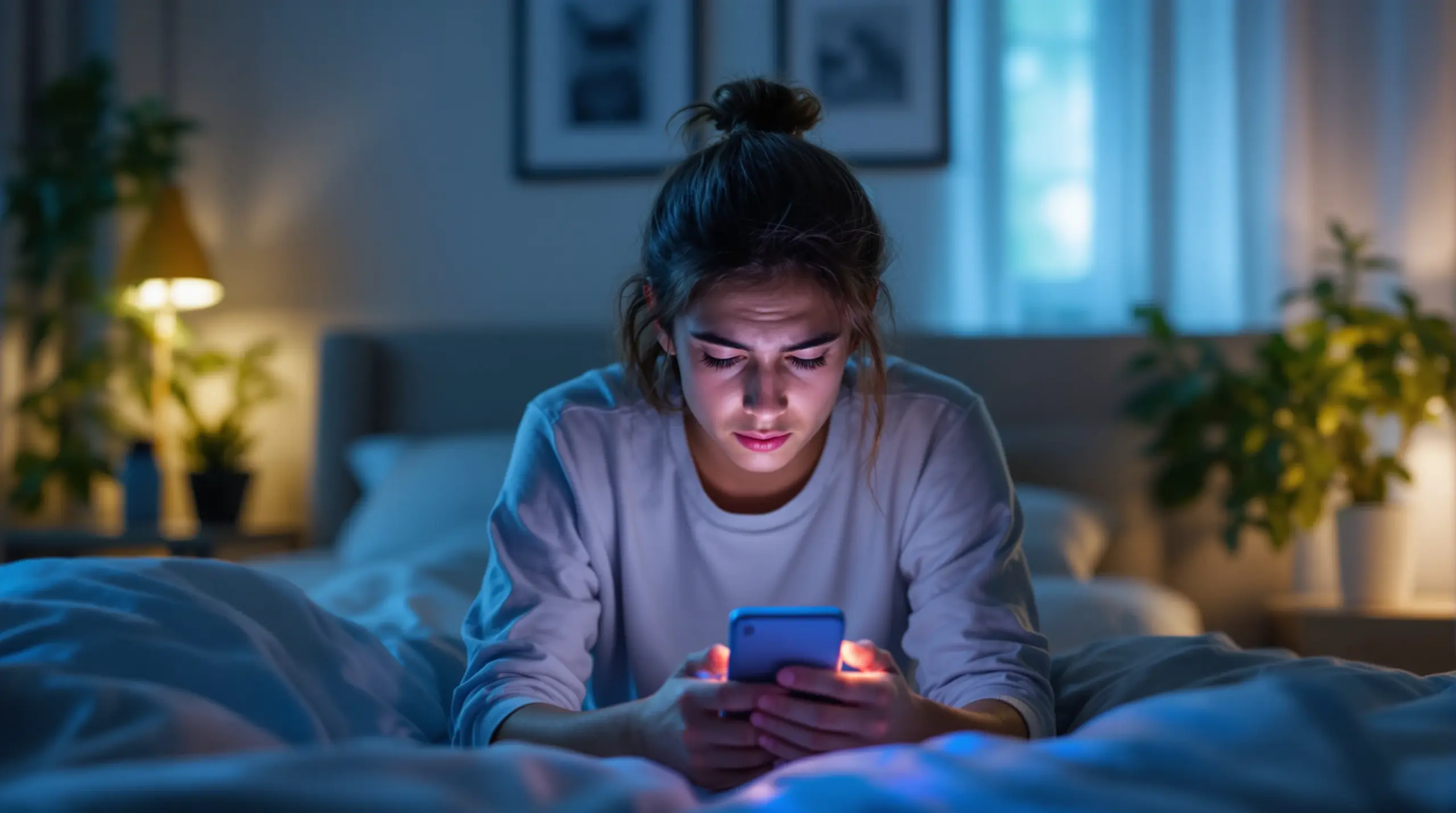
Sleep disruption is a third major pathway linking heavy social media use to adolescent mental health decline. Teens who use social platforms late at night – particularly in bed – experience delayed sleep onset, reduced sleep quality, and compounding effects on mood, attention, and emotional regulation the following day. The blue light emitted by screens and the emotionally stimulating nature of social content both interfere with the brain’s natural wind-down process.
Algorithm-driven content recommendation systems create a fourth risk factor by pushing increasingly extreme or emotionally intense content to keep users engaged. For a teen who is already struggling with low mood, an algorithm serves content that reinforces rather than interrupts negative thought patterns. Parents who monitor their teen’s YouTube viewing history on Android – a feature available through Boomerang Parental Control’s screen time features – spot these patterns early and start informed conversations before they escalate.
The Positive and Negative Effects of Social Media on Teen Wellbeing
Social media’s effects on teenage mental health are not uniformly negative – but the balance of evidence points more clearly toward harm than benefit at high usage levels. Understanding both sides of this equation helps parents make practical decisions rather than defaulting to either complete restriction or uncritical permissiveness.
On the positive side, social media provides meaningful peer connection for teens who are geographically isolated, socially anxious, or part of minority communities who do not find belonging easily in their immediate environment. Online friendships, interest-based communities, and access to peer support for shared experiences reduce loneliness and reinforce identity during a vulnerable developmental stage. According to Pew Research Center data from 2025, 10% of teens said social media helps their mental health (Pew Research Center, 2025)[2] – a minority, but a real one that should not be dismissed.
Social platforms also serve as channels for creative expression, skill development, and exposure to diverse perspectives. A teen who uses YouTube to learn a musical instrument, follows fitness content that motivates healthy habits, or engages with educational creators is experiencing a genuinely different product than one who is passively scrolling a curated social feed late at night.
However, the negatives at high usage levels are more numerous and better documented. Jennifer M. Katzenstein, Vice President of Psychology at Johns Hopkins All Children’s Hospital, observes: “Research has demonstrated that there are high rates of depression with very low social media use and very high social media use, demonstrating that there is a ‘sweet spot’ of use for each child that is often specific to their own developmental level and protective factors.” (Hopkins Medicine, 2024)[5]
This concept of a usage sweet spot is practically useful for parents. The goal is not to eliminate social media entirely – which is often both unrealistic and counterproductive – but to help teens find a balance that provides the social benefits without triggering the mental health costs. That balance looks different for a 10-year-old receiving their first device than it does for a 16-year-old with an established social life online. Parental controls that allow for gradual loosening of restrictions as a teen earns trust are far more effective than blanket bans that teens are motivated to work around.
You can read an independent review of how Boomerang approaches this balance at TechRadar’s Boomerang Parental Control software review.
What Parents Can Do to Protect Their Teens From Social Media Harm
Parents are the most powerful protective factor available to teenagers navigating social media – and that protection is most effective when it combines open communication with consistent, automated technical boundaries. Relying on willpower alone to limit screen time rarely works for adolescents; the platforms are deliberately engineered to maximize engagement, and a teenager’s developing brain is particularly susceptible to those mechanisms.
The first practical step is establishing daily time limits that apply across all social media apps on the device. On Android devices, tools like Boomerang Parental Control allow parents to set per-app time limits alongside an overall daily screen time allowance, so a teen cannot simply switch from one platform to another once TikTok runs out. This kind of automated enforcement removes the parent from the role of daily screen time police – the app handles the turn-off, which reduces household conflict significantly.
Scheduled downtime is equally important. Preventing device use after a set bedtime hour – say, 9:00 PM on a school night – addresses the sleep disruption risk directly. When the phone locks automatically at bedtime, parents do not need to have the same argument every night. The boundary is consistent, neutral, and cannot be negotiated away.
App approval controls add a third layer of protection by ensuring teens cannot download new social media apps without a parent’s knowledge and explicit sign-off. Many parents are unaware when their child moves from one platform to another, or creates a secondary account on a platform the parent thought they had restricted. Requiring parental approval for every new app installation – available on Android through Boomerang – closes that gap before it opens.
For parents concerned about communication safety, Call and Text Safety features on Android allow monitoring for keyword alerts in SMS messages, surfacing potential signs of cyberbullying or contact from unknown adults. SafeWise’s independent review of Boomerang Parental Control covers how these features function in a real family context. These monitoring tools are most effective when paired with open conversations about why parents are concerned – transparency builds trust and reduces the likelihood of teens seeking workarounds.
Your Most Common Questions
How many hours of social media use per day is considered harmful for teenagers?
Research identifies three hours per day as the threshold above which mental health risks increase significantly. Teens who exceed this level of daily social media use face twice the risk of depression and anxiety symptoms compared to those who use it less (U.S. Department of Health and Human Services, 2023)[1]. However, this threshold is a population-level finding, not a guaranteed safe limit for every individual. Younger teens, those with existing anxiety or depression, and those who primarily engage in passive scrolling rather than active interaction experience harm at lower usage levels. Parents should watch for behavioral signs – increased irritability, sleep problems, withdrawal from in-person activities, and declining academic performance – as indicators that their teen’s social media use is crossing into harmful territory, regardless of the raw hours involved.
Does the impact of social media on teenage mental health affect girls more than boys?
Research indicates that adolescent girls experience more severe mental health impacts from heavy social media use than boys, though both genders are affected. Girls are more likely to engage in social comparison behaviors – comparing their appearance, social status, and relationships to the curated content they see online – which drives stronger associations with body dissatisfaction, low self-esteem, and depression. Boys tend to use social media for gaming-adjacent content and active interaction, patterns that carry different but not necessarily lower risks. The key distinction is in the type of engagement: passive consumption of appearance-focused content is the highest-risk pattern, and girls engage in it at higher rates. Parents of daughters who use Instagram, TikTok, or similar platforms should be especially attentive to signs of body image concerns or social withdrawal following periods of heavy use.
What are the warning signs that social media is hurting my teen’s mental health?
The most common warning signs include persistent irritability or emotional distress after device use, difficulty sleeping or staying asleep, withdrawal from family and in-person friendships, a noticeable drop in academic performance or motivation, and expressions of low self-worth tied to how posts perform online. Physical signs like fatigue and difficulty concentrating during the day – often linked to late-night device use – are also common. If your teen becomes anxious or agitated when their phone is taken away, or if they are secretive about what they are viewing and who they are talking to online, those behaviors warrant a direct, calm conversation. Monitoring tools like YouTube App History viewing on Android (available through Boomerang) help parents identify concerning content patterns before they escalate into more serious issues.
Can parental control apps actually reduce the negative impact of social media on teenage mental health?
Parental control apps are most effective when they enforce consistent boundaries that willpower alone cannot maintain – particularly around daily time limits and bedtime device use. By automating the enforcement of screen time rules, apps remove the daily negotiation that exhausts both parents and teens and often ends in the teen getting more time than the parent intended. On Android devices, Boomerang Parental Control provides per-app limits, scheduled downtime, app approval controls, and uninstall protection that keeps rules in place even with tech-savvy teens. These tools work best as part of a broader strategy that includes age-appropriate conversations about why limits exist, gradual trust-building as teens show responsible use, and monitoring features that allow parents to spot risks early. Parental controls are not a substitute for parenting – but they are a significant force multiplier for parents who are already engaged.
Comparing Approaches to Managing Teen Social Media Use
Parents have several broad strategies available for managing their teenager’s social media use and its mental health effects. Each approach carries different tradeoffs in effectiveness, ease of implementation, and impact on the parent-child relationship. The table below compares four common methods across the dimensions that matter most to families.
| Approach | Effectiveness | Ease of Implementation | Bypass Risk | Supports Mental Health Goal |
|---|---|---|---|---|
| No restrictions (trust-based only) | Low for heavy users | Very easy – no setup | Not applicable | Weak – relies entirely on teen self-regulation |
| Built-in platform controls (e.g., Apple Screen Time, Google Family Link) | Moderate | Easy – built into device | High – frequently bypassed by tech-savvy teens | Moderate – limited by bypass vulnerability |
| Third-party parental control app (Android-focused) | High – enforces limits automatically | Moderate – one-time setup | Low – uninstall protection and Samsung Knox integration available[6] | Strong – addresses sleep, usage limits, content, and communication safety |
| Complete device removal | High for screen time reduction | High conflict – creates social isolation risk | Not applicable | Mixed – removes risks but also removes benefits and damages trust |
How Boomerang Parental Control Supports Teen Digital Wellness
Boomerang Parental Control – Taking the battle out of screen time for Android and iOS was designed to help parents address the mental health risks of teen social media use through automated, non-bypassable controls that work without requiring daily parental intervention. Our platform is built around the understanding that sustainable digital wellness requires both firm boundaries and genuine visibility into what teens are doing online.
For Android devices – where our deepest feature set lives – Boomerang gives parents per-app daily time limits so social media apps like TikTok and Instagram cannot consume more time than you decide is appropriate. Scheduled downtime automatically locks the device at bedtime, protecting sleep without a nightly argument. The App Discovery and Approval feature means your teen cannot download a new social platform without your explicit sign-off, giving you a gate on new risks before they become habits.
Our YouTube App History Monitoring (Android only) gives you visibility into what your child is actually watching – not just which app they opened, but the specific content drawing their attention. This feature supports the kind of informed, proactive conversation that is far more effective than reactive rule-setting after a problem has already developed.
For families with Samsung devices, Boomerang Parental Control is the only parental control app to use Samsung’s Knox, an enterprise-grade mobile security solution that makes the app virtually impossible for a tech-savvy teen to remove without your PIN – directly addressing the bypass frustration that defeats basic free tools.
“Hey fellow parents, So far this the best parental control app .. hands down. So far the only app my 11 year old was not able to bypass. Big Shout out to developers for making such a great app.” – Jason H, Google Play review
“This is a great application! I have control back over my child’s phone and applications because she managed to circumvent family link. I have no idea how she did that but she managed to find a way, as did other kids. That was a major frustration for us. But now with Boomerang, I can manage her time, what applications she uses and what sites she visits.” – Joe Eagles, Google Play review
iOS support is available with scheduled screen time, location tracking, and the SPIN Safe Browser – though the deepest features, including YouTube monitoring and per-app limits, remain Android-only. Subscriptions are available annually for a single device or as a Family Pack covering up to 10 child devices. Visit our sideload download page for Android devices to get started, or reach us at [email protected] with any questions.
Practical Tips for Families Navigating Social Media and Teen Mental Health
Managing the impact of social media on teenage mental health is an ongoing process, not a one-time setup task. The following strategies are grounded in the research and the real-world experience of parents who have navigated this challenge with their children.
Start with the three-hour guideline. Use it as a concrete starting point for your household rules. If your teen is currently using social media for five or six hours a day, move toward the three-hour limit gradually – a sudden sharp restriction often creates conflict that undermines the goal. Use a parental control app to enforce whatever limit you set automatically rather than relying on the teen to self-police.
Establish a device-free bedroom rule. Removing devices from the bedroom at a set time each night is one of the single most impactful changes a family can make for adolescent sleep quality and mental health. Automated scheduled downtime through an app like Boomerang makes this rule self-enforcing. A charging station in a common area of the home is a practical complement to this rule.
Talk about what you see, not just what you restrict. When you use monitoring tools to view your teen’s YouTube history or receive an alert about a new app installation, use that information to start a conversation – not to issue a punishment. Teens who understand why limits exist, and who feel heard in the process of setting them, are more likely to internalize healthy digital habits rather than simply working around the rules.
Use “Encouraged Apps” to balance restriction with positive access. On Android, Boomerang lets you designate educational or health apps as always available even when the daily screen time limit has been reached. This approach shows your teen that the goal is balance and healthy use, not blanket restriction – a message that is more motivating and relationship-preserving than pure prohibition.
Review and adjust limits as your teen grows. A good parental control strategy for a 10-year-old is not appropriate for a 15-year-old. Build in regular reviews – perhaps at the start of each school year – where you reassess limits in conversation with your teen. Gradual increases in freedom tied to shown responsibility give teens something to work toward and reinforce the trust-building goal that underlies all of this. You can also review independent assessments of parental control tools at Educational App Store’s Boomerang Parental Control review to stay informed about what features best match your family’s evolving needs.
The Bottom Line
The impact of social media on teenage mental health is real, well-documented, and directly addressable through a combination of informed parenting and the right digital wellness tools. The research is clear: teens who spend more than three hours daily on social media face significantly elevated risks of depression, anxiety, and disrupted sleep. But risk is not destiny – parents who set consistent boundaries, maintain open communication, and use effective monitoring tools reduce those risks meaningfully.
Boomerang Parental Control is built for exactly this challenge. Our Android-first platform automates the enforcement of screen time limits, protects bedtime, gates new app installs, and gives you visibility into what your child is watching – without requiring you to police the device manually every day. For families ready to take control of their teen’s digital environment, visit useboomerang.com or email us at [email protected] to get started today.
Sources & Citations
- Social Media and Youth Mental Health. U.S. Department of Health and Human Services.
https://www.hhs.gov/surgeongeneral/reports-and-publications/youth-mental-health/social-media/index.html - Teens, Social Media, and Mental Health. Pew Research Center, 2025.
https://www.pewresearch.org/internet/2025/04/22/teens-social-media-and-mental-health/ - The Impact of Social Media on the Mental Health of Adolescents and Young Adults: A Systematic Review. PMC, 2023.
https://pmc.ncbi.nlm.nih.gov/articles/PMC10476631/ - How Social Media Affects Your Teen’s Mental Health: A Parent’s Guide. Yale Medicine, 2024.
https://www.yalemedicine.org/news/social-media-teen-mental-health-a-parents-guide - Social Media and Mental Health in Children and Teens. Hopkins Medicine, 2024.
https://www.hopkinsmedicine.org/health/wellness-and-prevention/social-media-and-mental-health-in-children-and-teens - Boomerang Parental Control Samsung Knox Information. Boomerang Parental Control.
https://useboomerang.com/boomerang-parental-control-samsung-knox-information/
START YOUR FREE TRIAL
Take control of screen time—free for 14 days, cancel anytime.
