
31
Jul
2026
Boomerang vs MMGuardian: Which App Wins?
July 31, 2026
Comparing boomerang vs mmguardian helps parents choose the right parental control app for their family – discover key feature differences, platform strengths, and which tool fits your child’s Android or iOS device.
Table of Contents
- What Is boomerang vs mmguardian and Why Does It Matter?
- How Do Android Features Compare Between the Two Apps?
- iOS Support and Platform Limitations
- Which App Offers Stronger Bypass Protection?
- Frequently Asked Questions
- Feature Comparison Table
- How Boomerang Parental Control Can Help Your Family
- How to Choose Between Boomerang and MMGuardian in 5 Steps
- The Bottom Line
Quick Summary
boomerang vs mmguardian is a comparison of two family-focused parental control apps with different platform strengths. Boomerang leads on Android with Samsung Knox bypass protection, YouTube monitoring, and SMS safety. MMGuardian matches on Android basics but adds image scanning. Both have limited iOS depth.
Quick Stats: boomerang vs mmguardian
- Boomerang offers high bypass protection on supported Android devices through Samsung Knox integration – iOS protection is notification-only (Use Boomerang, 2025)[1]
- YouTube app monitoring and SMS and call safety features are both Android-only on Boomerang; neither is available on iOS (Use Boomerang, 2025)[1]
- SafeWise identifies only Bark, MMGuardian, and Canopy – three products total – as scanning images for inappropriate content in its review set (SafeWise, 2025)[2]
- Both Boomerang and MMGuardian are rated at moderate setup complexity in side-by-side review comparisons (Use Boomerang, 2025)[1]
What Is boomerang vs mmguardian and Why Does It Matter?
boomerang vs mmguardian is a direct comparison of two dedicated parental control apps designed to help parents manage their child’s Android or iOS device – and the differences between them have real consequences for how well the app works in your home. Boomerang Parental Control, founded in 2015, takes an Android-first approach that delivers deeper device integration, while MMGuardian positions itself as a broad-feature option available on both major platforms. Choosing the wrong app means paying for features your device does not fully support, or ending up with controls your tech-savvy child has already figured out how to bypass.
For parents handing a child their first Android smartphone, the decision matters from day one. Both apps cover the core parental control territory: screen time scheduling, web filtering, app management, and location tracking. The meaningful differences emerge when you look at platform depth, bypass resistance, and which monitoring features actually work on your child’s specific device. Families primarily using Android will find Boomerang’s feature set substantially deeper, while parents evaluating which app to trust on a Samsung Galaxy device will want to pay close attention to Knox integration – a capability that sets Boomerang apart from most competitors in this space.
START YOUR FREE TRIAL
Take control of screen time—free for 14 days, cancel anytime.



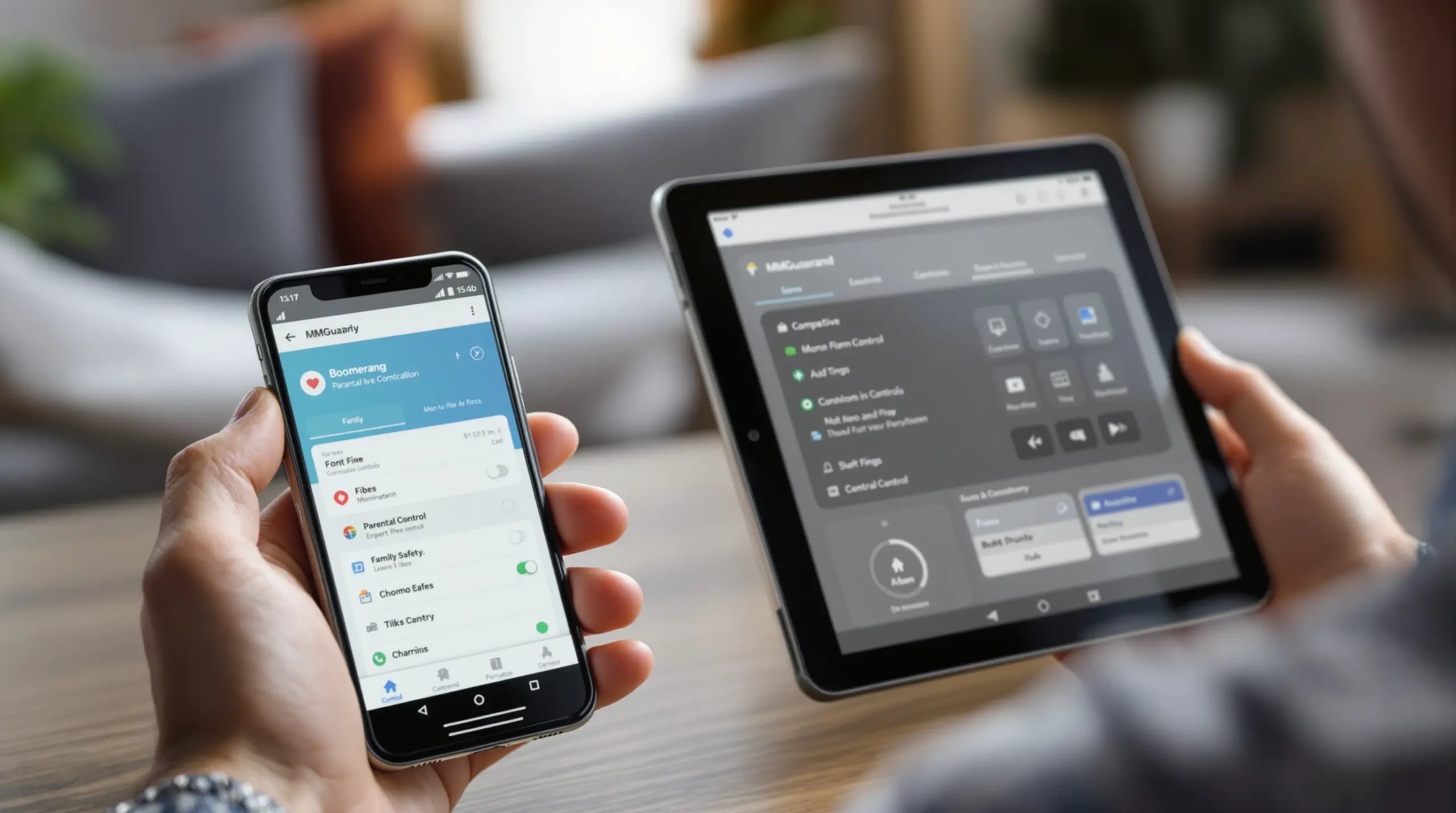
This comparison draws on published review data from 2025 to give you an honest, side-by-side picture of both apps across the features that matter most: Android capability, iOS limitations, bypass protection, and monitoring depth. Whether you are setting up a first device or replacing controls your child has already defeated, the sections below will help you make a confident decision.
How Do Android Features Compare Between the Two Apps?
Boomerang Parental Control delivers a wider and deeper Android feature set than MMGuardian, with several exclusive capabilities that MMGuardian does not match. The clearest example is YouTube app monitoring: Boomerang shows parents a history of what their child searches for and watches inside the main YouTube application on Android, while MMGuardian does not offer this feature (Use Boomerang, 2025)[1]. For parents worried about what their child is watching without their knowledge, that gap is significant.
On SMS and call safety, both apps provide Android coverage (Use Boomerang, 2025)[1]. Boomerang’s Call and Text Safety feature logs call and SMS history, sends alerts when inappropriate keywords appear in messages, and blocks calls from numbers not saved in the child’s contacts. MMGuardian also includes call and text monitoring on Android, which means parents evaluating communication safety features will find both apps viable on that platform.
Where MMGuardian distinguishes itself on Android is image scanning. As SafeWise noted in 2025, “Only Bark, MMGuardian, and Canopy scan images for inappropriate content” (SafeWise, 2025)[2]. Boomerang does not currently offer image scanning, so families where that specific capability is a priority will need to weigh it against Boomerang’s stronger YouTube monitoring and Knox-backed bypass protection.
Boomerang’s per-app time limits and Encouraged Apps system add another layer of Android functionality that goes beyond simple blocking. Parents set a 30-minute daily limit on a game while marking a school portal or reading app as always available – a balance-focused approach that MMGuardian’s feature set does not replicate in the same way. For families that want to guide healthy digital habits rather than apply blanket restrictions, that distinction matters in day-to-day use. You can explore Boomerang Parental Control screen time features to see exactly how flexible scheduling and per-app controls work together.
iOS Support and Platform Limitations
Both Boomerang and MMGuardian support iOS devices, but neither app delivers the same depth on iPhone and iPad that they provide on Android – and parents choosing primarily for an iOS household should understand those limits before subscribing. As TechRadar noted in 2025, “Boomerang’s Android experience is generally stronger than its iOS experience, especially for restrictions and monitoring features” (TechRadar, 2025)[3].
Boomerang’s iOS feature set covers three core areas: scheduled screen time, location tracking, and safe browsing through the SPIN Safe Browser. YouTube app monitoring is not available on iOS, and neither are SMS and call safety features – both remain Android-only (Use Boomerang, 2025)[1]. Uninstall protection on iOS is notification-only rather than the active enforcement that Samsung Knox provides on supported Android devices. Parents of iPhone users receive an alert if the app is removed, but the app cannot prevent removal the way it does on Android.
MMGuardian’s iOS limitations follow a similar pattern. SafeWise observed in 2025 that “MMGuardian is best known for a broad feature set, but several review sources note that its iPhone feature depth is more limited than its Android version” (SafeWise, 2025)[4]. Apple’s operating system restrictions prevent third-party apps from accessing SMS content, blocking individual apps, or monitoring calls at the system level – constraints that affect every parental control app in the market, not just these two.
The practical takeaway for parents is straightforward: if your child uses an Android device, both apps offer meaningful control. If your child uses an iPhone, both apps are limited by Apple’s platform rules. Families with mixed households – one child on Android, another on iOS – will find Boomerang’s unified dashboard useful, while understanding that the Android child will have significantly more comprehensive coverage than the iOS child. This is not a flaw unique to Boomerang; it reflects the reality of how Apple and Google approach third-party app permissions differently.
Which App Offers Stronger Bypass Protection?
Boomerang Parental Control offers stronger bypass protection on Android than MMGuardian, primarily because of its Samsung Knox integration, which provides enterprise-grade security that makes the app exceptionally difficult for children to remove or circumvent. As documented in a 2025 review, “Boomerang Parental Control offers high bypass protection on supported Android devices through Samsung Knox, while iOS support is more limited and notification-only” (Use Boomerang, 2025)[1]. Knox is an enterprise mobile security framework pre-installed on most Samsung smartphones and tablets, and Boomerang is the only consumer parental control app to use it for uninstall protection.
For parents who have already experienced a child deleting Google Family Link or disabling Apple Screen Time, this distinction is not a minor technical detail – it is the reason the app continues working after the child discovers it. Boomerang Parental Control is the only parental control app to use Samsung’s Knox, an enterprise mobile security solution pre-installed in most Samsung smartphones and tablets, giving parents a level of enforcement confidence that general-purpose uninstall protection cannot match.
MMGuardian also includes uninstall protection on Android, but its approach does not use Knox, which means a determined and technically capable teenager has more avenues to attempt removal. TechRadar noted in 2025 that “MMGuardian is reviewed as a feature-rich parental control option, but setup and platform differences can affect how well it fits a family’s needs” (TechRadar, 2025)[5]. For families with younger children on non-Samsung Android devices, the gap in bypass resistance is smaller. For parents of teenagers on Samsung Galaxy devices specifically, Boomerang’s Knox advantage is a material differentiator.
On iOS, neither app provides active uninstall prevention due to Apple’s platform restrictions. Both apps rely on notification-based alerts to inform parents if the app is removed, which means the protection model on iPhone is awareness rather than prevention. Parents relying on iOS-only protection should factor this into their device and app choice decisions from the start.
Your Most Common Questions
Does Boomerang work on iPhone as well as Android?
Boomerang Parental Control supports both iPhone and Android, but its full feature set is available only on Android devices. On iOS, Boomerang provides scheduled screen time controls, real-time location tracking, and safe web browsing through the SPIN Safe Browser. Features including YouTube app history monitoring, SMS and call safety alerts, per-app time limits, and Samsung Knox-backed uninstall protection are Android-only and do not function on iPhone or iPad. Apple’s platform rules prevent third-party apps from accessing SMS content, blocking individual apps, or providing active uninstall prevention, which limits what any parental control app – including Boomerang and MMGuardian – can deliver on iOS. If your child uses an iPhone, Boomerang still provides useful location and browsing protections, but the monitoring depth available on an Android device will not be replicated. Families with children on both platforms should set expectations accordingly, and should consider whether an Android device gives their child access to more comprehensive parental oversight from day one.
What does MMGuardian offer that Boomerang does not?
MMGuardian offers image scanning for inappropriate content on Android, a capability that Boomerang does not currently include. According to SafeWise in 2025, only Bark, MMGuardian, and Canopy scan images for inappropriate content among the apps in its review set (SafeWise, 2025)[2]. MMGuardian flags or alerts parents when a child receives or saves a photo that contains nudity or explicit material – a feature that goes beyond URL filtering and app blocking. For parents whose primary concern is visual content shared through messaging or saved to a device, that capability is a meaningful reason to look more closely at MMGuardian. Outside of image scanning, both apps cover broadly similar ground on Android: web filtering, screen time scheduling, app management, location tracking, and SMS and call monitoring. MMGuardian also positions itself as a broad-platform option, though its iPhone feature depth is more limited than its Android version, as noted by multiple review sources in 2025. The choice between the two apps comes down to whether image scanning or Knox-backed bypass protection matters more for your specific family situation.
Can my child bypass or uninstall Boomerang on a Samsung phone?
On a Samsung Android phone, Boomerang Parental Control is exceptionally difficult for a child to bypass or uninstall because it integrates with Samsung Knox, an enterprise-grade mobile security framework built into most Samsung devices. Knox allows Boomerang to enforce uninstall protection at a system level that standard app removal attempts cannot override – a significant advantage over parental control apps that rely on standard Android permissions alone. Parents who have already experienced their child deleting Google Family Link or disabling simpler controls will find Knox integration changes that dynamic entirely. The protection applies to supported Samsung smartphones and tablets. On non-Samsung Android devices, Boomerang still includes uninstall protection, but the Knox-level enforcement is Samsung-specific. On iOS devices, neither Boomerang nor any third-party parental control app actively prevents removal – Apple’s platform only allows notification-based alerts when an app is deleted. If bypass resistance is your top priority and your child uses a Samsung device, Boomerang’s Knox integration is the strongest protection available in the consumer parental control market.
How does Boomerang’s YouTube monitoring compare to MMGuardian’s?
Boomerang Parental Control includes YouTube app history monitoring on Android, allowing parents to view what their child searches for and watches inside the main YouTube application – a feature that MMGuardian does not offer on either platform (Use Boomerang, 2025)[1]. This distinction matters because YouTube is one of the most-used apps on children’s devices, and standard web filters do not capture what a child watches inside a native app. Boomerang’s YouTube monitoring gives parents visibility into the content their child is actively seeking out, making it possible to spot trends or concerns and have an informed conversation rather than reacting after the fact. The feature is Android-only – it does not function on iPhone or iPad regardless of which parental control app is installed, because Apple’s platform does not provide third-party apps access to native application activity in the same way Android does. If your primary device concern is what your child watches on YouTube, an Android device running Boomerang is the combination that delivers actual monitoring capability, while MMGuardian on any platform leaves that particular visibility gap open.
Boomerang vs MMGuardian: Feature Comparison
The table below compares Boomerang Parental Control and MMGuardian across the features parents most commonly ask about when evaluating parental control apps for Android and iOS devices. Platform availability is noted where features differ by operating system.
| Feature | Boomerang Parental Control | MMGuardian |
|---|---|---|
| Screen Time Scheduling | Android and iOS | Android and iOS |
| Per-App Time Limits | Android only | Android (limited iOS) |
| Web Filtering | Android and iOS via SPIN Safe Browser | Android and iOS |
| App Approval Control | Android and iOS | Android and iOS |
| YouTube App Monitoring | Android only (Use Boomerang, 2025)[1] | Not available (Use Boomerang, 2025)[1] |
| SMS and Call Safety | Android only (Use Boomerang, 2025)[1] | Android only (Use Boomerang, 2025)[1] |
| Image Scanning | Not available | Available on Android (SafeWise, 2025)[2] |
| Location Tracking and Geofencing | Android and iOS | Android and iOS |
| Uninstall Protection | Android with Samsung Knox; iOS notification-only (Use Boomerang, 2025)[1] | Android (no Knox); iOS notification-only |
| Setup Complexity | Moderate (Use Boomerang, 2025)[1] | Moderate (Use Boomerang, 2025)[1] |
| Encouraged Apps (Educational Bypass) | Android only | Not available |
How Boomerang Parental Control Can Help Your Family
Boomerang Parental Control is built specifically for parents who want more than a basic screen time timer – it is a parental control platform that automates enforcement, provides genuine visibility into what your child is doing online, and stays in place even when your child tries to remove it. For families with Android devices, particularly Samsung Galaxy smartphones and tablets, Boomerang delivers a feature set that no free built-in tool can match.
Boomerang Parental Control – Taking the battle out of screen time for Android and iOS covers the full range of daily parenting needs: automated daily screen time limits that lock the device without an argument, bedtime scheduling that runs itself, per-app limits that let you allow 30 minutes of a game while keeping the school portal always available, and web filtering through the SPIN Safe Browser that blocks inappropriate content on any network without requiring a VPN.
Two Boomerang users summed up the experience directly. “This is a great application! I have control back over my child’s phone and applications because she managed to circumvent family link… But now with Boomerang, I can manage her time, what applications she uses and what sites she visits.” – Joe Eagles, Google Play review. And from a parent focused on bypass protection: “Hey fellow parents, So far this the best parental control app.. hands down. So far the only app my 11 year old was not able to bypass.” – Jason H, Google Play review.
Boomerang offers subscription plans for single devices and a Family Pack for up to 10 child devices. Setup is guided and designed for non-technical parents, with daily emailed activity reports keeping you informed without requiring you to open the app each day. If you have questions, the support portal and knowledge base are available at Contact Us. To get started on an Android device, visit the sideload download page for Android devices for installation instructions.
How to Choose Between Boomerang and MMGuardian in 5 Steps
Step 1: Identify Your Child’s Device Platform
Confirm whether your child’s device runs Android or iOS before comparing any other feature. Both Boomerang and MMGuardian deliver their strongest capabilities on Android. If your child uses a Samsung Galaxy device, Boomerang’s Knox integration gives it a clear advantage in bypass protection. If your child uses an iPhone, both apps are limited by Apple’s platform rules, and the feature gap between the two narrows considerably.
Step 2: Decide Which Monitoring Features Matter Most to You
List your top three concerns – for example: screen time conflict, YouTube content, image safety, or location tracking. Boomerang leads on YouTube app history monitoring and SMS safety on Android. MMGuardian leads on image scanning. If multiple concerns apply, map each one to the app that covers it, then choose the app that addresses the majority of your priority list.
Step 3: Assess Your Child’s Likelihood of Attempting Bypass
If your child is a teenager who has already defeated Google Family Link, Apple Screen Time, or a previous parental control app, bypass resistance should move to the top of your decision criteria. Boomerang’s Samsung Knox integration on supported devices is the strongest uninstall protection available in the consumer parental control market. MMGuardian offers Android uninstall protection but does not use Knox, making it more vulnerable to a technically motivated teenager.
Step 4: Consider Whether Screen Time Balance or Pure Restriction Is Your Goal
Boomerang’s Encouraged Apps feature lets parents designate educational or health apps as always available, even when the child’s daily screen time limit has been reached. This makes it possible to restrict entertainment without blocking homework tools – a balance-focused model that suits families working toward healthy digital habits rather than total lockdown. If guided habit-building alongside firm limits is your priority, Boomerang’s approach aligns more closely with that goal.
Step 5: Trial and Evaluate Before Committing Long-Term
Both apps offer subscription plans with different pricing tiers. Before committing to an annual plan, test the app on your child’s specific device to confirm the features you need work as expected. Pay particular attention to how the app handles your child’s primary device model and whether the monitoring features you selected in Step 2 are fully functional – not just listed as available on the platform. Independent reviews from sources like SafeWise’s Boomerang Parental Control Review and TechRadar’s Boomerang Parental Control software review help confirm real-world performance before you buy.
The Bottom Line
In the boomerang vs mmguardian comparison, the right choice depends on your child’s device, your primary safety concerns, and how tech-savvy your child is. On Android – especially Samsung – Boomerang Parental Control leads with YouTube monitoring, SMS safety, Encouraged Apps, and Knox-backed bypass protection that MMGuardian cannot match. MMGuardian offers image scanning that Boomerang does not. On iOS, both apps are limited by Apple’s platform, and the gap between them narrows significantly.
For most families with Android devices who want automated enforcement, genuine visibility, and protection that holds against a determined child, Boomerang delivers the more complete package. To see everything Boomerang offers and get started today, visit Boomerang Parental Control – Taking the battle out of screen time or reach out directly at [email protected].
Sources & Citations
- Honest MMGuardian Review: What Parents Should Know. Use Boomerang.
https://useboomerang.com/article/mmguardian-review/ - Boomerang Parental Control Review. SafeWise.
https://www.safewise.com/kids-safety/parental-control-apps/boomerang/ - Boomerang Parental Control software review. TechRadar.
https://www.techradar.com/reviews/boomerang-parental-control-software - MMGuardian Parental Control App Review. SafeWise.
https://www.safewise.com/kids-safety/parental-control-apps/mmguardian/ - MMGuardian Parental Control Software Review. TechRadar.
https://www.techradar.com/reviews/mmguardian-parental-control-software-review
START YOUR FREE TRIAL
Take control of screen time—free for 14 days, cancel anytime.
